A Royal Society Science Community Programme, 2026 to 2029
Tomorrow’s Climate Scientists brings primary schools and STEM professionals together to investigate real climate change and sustainability questions, right on pupils’ doorsteps.
Over three years, 25 primary schools across South Yorkshire will each be partnered with a STEM professional from a local university or industry. Together, teachers and their STEM partners will plan and run hands-on investigations in curriculum time, exploring questions that matter to their school and community. How clean is the air outside our school gates? Could our roof power the school with solar panels? Where does the heat escape from our building? What lives in our school grounds, and how could we help it thrive?
Teachers lead the learning. STEM professionals bring real-world expertise, help pupils make sense of their data, and show children that science is something people like them do. Along the way, pupils build their enquiry skills: asking questions, collecting and analysing data, and sharing what they find.
What makes it different
Long-term partnerships. Schools and STEM professionals work together across three years, not just for a one-off visit, so the relationships and confidence grow over time.
Real science, real places. Every investigation is rooted in the school’s own building, grounds and local area.
Built into the curriculum. Investigations link to working scientifically, maths and geography, so they enrich teaching rather than adding to it.
A community, not just a project. Schools and STEM professionals join a growing network with shared CPD, resources and celebration events where pupils showcase their findings.
Support to go further. Participants get help to apply for Royal Society Partnership Grants, so the work can carry on beyond the programme.
Investigation themes
Air quality, renewable energy, energy efficiency of school buildings, flood risk and sustainable drainage, and biodiversity in school grounds.
Building on success
The programme builds on our Royal Society seed-funded pilot (2024 to 2026), where 25 primary teachers and 25 STEM professionals worked together on climate investigations across South Yorkshire.
Get involved
We are now recruiting for the programme, which starts in January 2027. Please register your interest by Friday 6 November 2026.
Tomorrow’s Climate Scientists is led by the Sheffield Institute of Education at Sheffield Hallam University and funded by a grant from the Royal Society and the Julia Rausing Trust.
Would your pupils love to work alongside a real scientist on an investigation that matters to their local area? We have 25 places for South Yorkshire primary schools on Tomorrow’s Climate Scientists, a new three-year programme funded by the Royal Society and the Julia Rausing Trust.
Each year, one of your classes will run a practical climate or sustainability investigation in curriculum time, over about half a term. You’ll be partnered with a STEM professional from a Sheffield university or industry, who will visit your school to launch the investigation, help with the data and celebrate what pupils find. You can choose from themes such as air quality, renewable energy, energy efficiency of your school building, flood risk and biodiversity in your school grounds.
Why take part?
Pupils do real science on real issues in their own school and community, and get to meet the kind of people who do STEM jobs.
It fits into what you already teach. The investigations link to working scientifically, maths and geography, so they add to your curriculum rather than sitting on top of it.
Your school receives £700 of investigation equipment to keep (things like air quality sensors and renewable energy kits), plus £1,425 towards supply cover and travel over the three years.
Staff get practical CPD, planning time with your STEM professional, and the option of accredited Carbon Literacy training.
You’ll join a friendly network of local schools, with shared resources, celebration events, and support to apply for a Royal Society Partnership Grant of up to £3,000.
This builds on our Royal Society seed-funded pilot, where 25 primary teachers and 25 STEM professionals worked together on climate investigations across South Yorkshire. We’re really excited to take it further.
We’re asking schools to commit to all three years, with support from a senior leader, and for a member of staff to attend the CPD and network sessions. If we have more interest than places, we’ll prioritise schools with higher proportions of pupils eligible for free school meals, with SEND or EAL, and schools with less access to STEM enrichment.
The flyer below has all the details. If you have any questions, or would like a quick chat about whether it’s right for your school, please get in touch.
STEM Professional recruitment – deadline 6 November 2026
Do you work in climate, environmental science, biodiversity, engineering or data? Have you ever wondered what a class of nine year olds would make of your research? We’d love you to find out.
We’re recruiting STEM professionals for Tomorrow’s Climate Scientists, a new three-year programme funded by the Royal Society and the Julia Rausing Trust. You’ll be partnered with a primary school in South Yorkshire, and each year you’ll work with a teacher and their class on a hands-on climate or sustainability investigation. Themes include air quality, renewable energy, flood risk and biodiversity in school grounds.
This isn’t about standing at the front and teaching. The teacher leads the lessons. You bring the real-world science, help pupils make sense of their data, and show them what a scientist actually looks like (often not what they expect!). That works out as three school visits per investigation, with a bit of light online contact in between.
Why get involved?
It’s genuinely rewarding. Pupils remember the day a real scientist came to help with their investigation, and teachers tell us it changes how children see STEM and themselves.
You’ll build your public engagement and communication skills, with training and support from our team so you’re never thrown in at the deep end.
It’s great evidence for your CV, PhD, promotion case or impact work.
We cover the practical stuff: travel costs, a free DBS check, and all the kit and resources your school needs.
You’ll join a friendly network of schools and STEM professionals, with celebration events where pupils share what they’ve found.
This builds on our Royal Society seed-funded pilot, where 25 STEM professionals and 25 primary teachers worked together on climate investigations. It went brilliantly, and we’re excited to grow it.
Ideally we’re looking for people who can commit to all three years, but at a minimum to the end of this academic year. Postgraduate and early career researchers are very welcome.
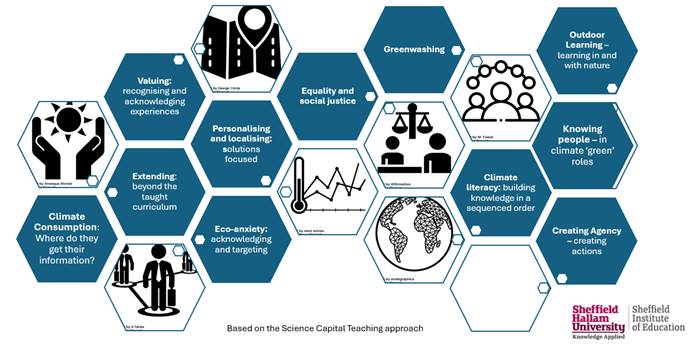
The RICE framework, developed by academics at Sheffield Hallam University, supports high-quality climate education by building climate knowledge (what students understand), motivation (why they care), and agency (what they feel able to do). The framework builds on the Science Capital Teaching Approach. The framework broadly covers eleven themes:
Climate Literacy – structured, age-appropriate knowledge that builds understanding over time Valuing – recognising students’ existing experiences and connecting to new learning Personalising and localising – grounding climate in local, actionable contexts
Extending beyond taught curriculum – learning through clubs, projects, communities Climate Consumption – critical thinking about where climate information comes from
Eco-anxiety – explicitly addressing fear and worry, turning it into constructive action
Equality and social justice – understanding who climate change affects most Greenwashing – teaching students to critically evaluate climate claims
Knowing people in climate ‘green’ roles – exposure to real climate careers and pathways
Creating Agency – empowering students to act at individual, school, and community levels
Outdoor Learning – direct experience in natural environments for deeper understanding and connection
Several recent projects delivered by Sheffield Hallam University have used utilised the framework to develop and deliver teacher CPD and curriculum programmes, including:
Each component plays a distinct but interconnected role:
1. Climate Literacy (sequenced knowledge)
Why it matters: A structured, age-appropriate progression of climate knowledge ensures students build accurate understanding over time – avoiding misconceptions and fragmentation.
Knowledge: Develops core scientific and socio-ecological understanding
Motivation: Reduces confusion and overwhelm
Agency: Enables informed decision-making
2. Valuing: recognising and acknowledging experiences
Why it matters: Students come with existing experiences of weather, environment, and climate. Recognising these validates identity and supports inclusion.
Knowledge: Connects prior knowledge to new learning
Motivation: Builds relevance and belonging
Agency: Encourages participation and voice
3. Personalising and localising (solutions-focused)
Why it matters: Grounding climate change in local contexts makes it tangible and actionable.
Knowledge: Links global concepts to lived realities
Motivation: Increases perceived relevance
Agency: Highlights realistic, place-based actions
4. Extending beyond the taught curriculum
Why it matters: Climate learning happens beyond lessons – through clubs, projects, communities, and informal learning.
Knowledge: Deepens and broadens understanding
Motivation: Sustains engagement over time
Agency: Provides real-world opportunities to act
5. Climate Consumption (where do they get their information?)
Why it matters: Students are exposed to climate narratives through media and social platforms, which can shape understanding and attitudes.
Knowledge: Develops critical media literacy
Motivation: Counters misinformation and apathy
Agency: Empowers informed judgement and dialogue
6. Eco-anxiety: acknowledging and targeting
Why it matters: Climate change can provoke anxiety, fear, or helplessness. Addressing this explicitly is essential for wellbeing and engagement.
Knowledge: Helps interpret risks appropriately
Motivation: Prevents disengagement or denial
Agency: Reframes concern into constructive action
7. Equality and social justice
Why it matters: Climate change is unevenly experienced. Understanding justice dimensions fosters ethical and global awareness.
Knowledge: Builds understanding of inequalities and impacts
Motivation: Strengthens moral purpose
Agency: Encourages advocacy and fairness-oriented action
8. Greenwashing
Why it matters: Students need to critically evaluate claims made by organisations, governments, and media.
Knowledge: Develops critical thinking and scrutiny
Motivation: Builds trust in credible solutions
Agency: Supports informed choices and accountability
9. Knowing people in climate ‘green’ roles
Why it matters: Exposure to real people working in climate-related roles expands horizons and challenges stereotypes.
Knowledge: Increases awareness of pathways and careers
Motivation: Builds aspiration and relevance
Agency: Helps students see themselves as future contributors
10. Creating Agency (taking action)
Why it matters: Ultimately, climate education should empower students to act meaningfully at individual, school, and community levels.
Knowledge: Applies learning in practical contexts
Motivation: Reinforces purpose and efficacy
Agency: Builds confidence to make change happen
11. Outdoor Learning (learning with and in nature)
Why it matters: Direct experiences in natural environments deepen understanding, strengthen emotional connections, and make climate and sustainability learning tangible rather than abstract.
Knowledge: Enhances understanding of ecosystems, biodiversity, and environmental processes through real-world observation
Motivation: Builds connection to nature (linked to measures like Connectedness to Nature), increasing care and concern
Agency: Encourages stewardship behaviours and empowers students to take action in their immediate environment
Bringing it together
The strength of RICE lies in its integration:
Knowledge is built through structured, contextualised learning
Motivation is fostered through relevance, justice, and emotional engagement
Agency is developed through opportunities to act, reflect, and see impact
Together, these elements move climate education beyond awareness – towards informed, empowered, and active learners.
Friday 5th February 2027 and in-depth workshop at Green Estate, Thursday 4th February 2027
We are pleased to confirm we will be hosting a national conference at Sheffield Hallam University on Friday 5th February 2027, funded by the MACC Hub. The conference will bring together practitioners and researchers in education focussing on climate adaptation from across the UK.
We’ll be showcasing research from a MACC funded project by Sheffield Hallam called Adapt-Ed – investigating how primary schools can deliver climate adaptation education in the national curriculum. We’ll also present researching and findings from Sheffield City Council’s Built for Change programme – climate adaptation in education settings in Sheffield, along with other keynote speakers and workshops.
We’ll also be co-hosting an in-depth workshop about our project at the Green Estate on the afternoon of Thursday 4th February – you are welcome to attend either event or both.
There will be lots more to follow. In the meantime if you would like to book an early spot you can use these links: In-depth workshop at Green Estate (Thursday 4 February 2027) and Conference attendance (Friday 5 February 2027).
Information for presenters and information stall requests
Friday 5 February 2027 – Sheffield Hallam University
Information for teachers, researchers and organisations that would like to present or host a stall. We expect in the region of 150 people to attend the conference.
The theme of the conference is climate adaptation in education. This may include the curriculum, the campus and the community – how schools and education settings are implementing changes within their curriculum, how they are adapted their buildings or how they are changing their grounds to be more resilient.
Workshops and presentation
Workshops and presentations should be about climate, nature or sustainability in education and those with an adaptation focus will be prioritised. The audience will be teachers and school staff, researchers in education and organisations that have an interest in climate change, sustainability and nature. If you are presenting academic research, please remember that this should be presented to a wide-ranging audience (for example avoiding jargon, signposting relevance to teachers, accessible resources). There will be a maximum of three slots during the day. Workshop rooms will have access to a screen and PC/bring your own device. We are unable to contribute towards travel or accommodation or provide a presenter fee.
Workshops and presentations are 45 minutes long.
Key dates:
Workshops and presentations invite opens: 1 September 2026
Deadline for submissions: Friday 6 November 2026, 23:59
We will have a limited number of information stands available for organisations to showcase their work. A table and 2 chairs will be provided per stand. A plug socket will be available. There will be space for pop up banners and table top displays. There will be opportunities for attendees to visit stalls during the breaks and extended lunch. Stalls are provided free to charities and organisations that provide free resources. If you are a private company, there is likely to be a cost (further details on the submission form).
Key dates:
Stalls invite opens: 1 September 2026
Deadline for submissions: Friday 27 November 2026, 23:59
What made you choose air quality and energy loss as your investigation topics?
Teacher: I got involved in the project and I just expressed an interest in getting more involved with the climate side. The school had to start putting together a sustainability plan and everything, and I just it was something I was more interested in becoming involved with. So our business manager said all these projects come through, would you like to take part? Yeah, I was kind of just intrigued by it. We did two investigations actually. We were looking at air quality and we also looked at energy loss with the thermal cameras.
How did you structure the activities?
Teacher: We use the CO2 monitors to measure the air quality inside. Then the children, we also use the magnifying glasses and the sheets to look for evidence of lichen growing outside. We also borrowed the thermal cameras because we wanted to look where we were losing energy, which I think the children found interesting, but I feel like they focused probably more on the air quality side of it in the end. Before we started the project, the first session we did with the children, we gave them a bit of a background, like what air quality is. And the children selected the areas where we were going to measure the air quality. So they thought about the different parts inside school they wanted to measure and they were already coming up with ideas like, well, it might be worse there because there’s more people in that space or like the dining hall, they said all the doors opening and closing all the time, so actually it might be better there.
What surprised you most?
Teacher: I think I was probably only surprised really at how engaged the children were. Yeah, the core group were just so enthusiastic, and I think I didn’t know if I expect them to be quite as enthusiastic as that. And I think also just the awareness that some of the children already had about climate issues. I think it brings it home, like how actually in younger people, it is already something a lot of them are thinking about, which maybe as an adult, we don’t quite always see that as much.
What have you taken from this experience?
Teacher: We’ve got now a little sustainability team within schools, so I’ve been part of that team, which I’m really pleased about. The air quality stuff was really interesting and we still got a little bit more to do on it actually and the children I worked with were really passionate and they keep nagging me about, can we get this finished? Can we go on to the next part of it? It’s made me definitely more engaged, a lot more thinking about sustainability issues and definitely climate issues. Just some of the results we saw, I would say it’s definitely affected that approach to just making sure windows are open and that airflow is good.
What happens next?
Teacher: The children shared their results with the head teacher. So the plan is they are now going to be doing an assembly for the whole school. And they’ve also come up with ideas that they discussed with the head teacher about things they want to see. They want to make sure windows are open on a regular basis in every classroom. They want to do things like try and get every classroom to have an indoor plant, get more outdoor greenery. Yeah, things like that will be beneficial to the school in the long run. I am planning to apply for additional funding. It’s just in year six we have SATS and lots of other stuff, so I’m just waiting until that’s out of the way because I want some time to really look at all the projects that are already in place, see what other schools have done. I really like the idea of getting more greenery in school and the impact of that. Our researcher, who I worked with on the project, she did express an interest in taking part if we took it further. So hopefully if she was still willing to do that, then I’d have the partner there from the STEM side.
What made you choose solar panels as your investigation topic?
Researcher: It was mainly because it was pretty much related to what I’m doing right now. I am working in an energy field area and that’s the closest part of it. And the teacher as well agreed to do that. Because it was my very first time to meet students in primary schools, I decided to have year six students rather than the younger one, because I know it might face some difficulties in terms of explaining the science to them.
How did you structure the activities?
Researcher: They did have some basic understanding, I would say, about this solar panel kit. So it was very interesting. They had more questions and they were excited because it’s a hands-on project, right? You can see the change immediately if we change the angle, if we change the LED and if you change the electrical devices, will it work or not? I also put an example specifically in Sheffield to, because we talked about other possibilities in terms of renewable energy, not only solar panel, but we also talked about wind and also hydro, the dome and the reservoir. I put the example about the Ladybower, so that they know that now we share it, we do have that, and it’s also possible to expand more.
What surprised you most?
Researcher: I actually initially expected that I would have kind of partner or another person that belongs to the same group as me. So I think I would expect that I would have a friend to have a discussion, because I was quite nervous to go to the school and especially it wasn’t located in Sheffield. But I think I managed all of them very well because I did visit kind of three times. And they also helped, the school provided some help to bring the kit to the class as well.
What have you taken from this experience?
Researcher: I feel that I have some improvements because after that, I’m still in contact with the research team and have included me in several events after that. So it really developed my confidence actually and I have several experiences working with schools voluntarily after that. So now I have a wide experience, not only for year six, I have also had experience with year two and year four. I know what kind of language that I could deliver because this study is quite specific. In terms of communication, it has some changes because you know it has a different audience. So you need to make sure that at which part that they understand so far and then from that we can continue.
What happens next?
Researcher: I would love to help with additional funding, I am happy to help and I’ve already said this to the research team. So I’m open to any opportunities. I think the programme, I think it’s because we are trying to put science closer to the students and in a very simple way. I think it’s important to give them the fun part of the science so that they want to know more later, or at least they are happy to learn about science and engineering.
What made you choose wind and renewable energy as your investigation topic?
Researcher: Well, for the second part of the year, autumn, the topics that the teacher from the Primary School were related to energy forces. And we opted to go for activities that already existed and a colleague recommend activities like the land yachts that was one. The teacher had an activity using a piece of cloth, like a sock, attached to a plastic bottle so the students could make bubbles and measure their displacement over a football field to give them an idea of wind.
How did you structure the activities?
Researcher: Eventually, the students conducted a third activity, and they built their own windmill, but at a small scale, following the reading of The Boy Who Harnessed the Wind, which is a very popular reading among primary school students. And finally, the students, led by the teacher, designed a small model of a sustainable city, including some renewable energy sources like wind, solar, and they had the most amazing ideas creating paths for cyclists, they reflected on water supply, parking for disabled people. Brilliant work, honestly.
What surprised you most?
Researcher: Well, the weather. The weather at that time we were expecting wind and there was no wind. So that changed things a bit. We went to the windiest part of the school, the open field. For the next session, for the yacht session, the teacher thought of a piece of paper or cardboard, so the students would produce some wind. And that in retrospective, I think that was a great idea. When the students build their own windmill, the windmill was a bit flimsy, but at some point the students were a bit like, is it really going to work?
What have you taken from this experience?
Researcher: My approach was enriched because it is a different country, different culture, it was a primary level, and you have to get familiar with the language used to engage with these primary school students. The way you have to explain things was an amazing challenge. It was brilliant and they are amazing. I used to teach these things to high school and university students, but it was amazing to me how a ten-year-old was actually conceiving that in his own words. I find that very, very motivating and I needed that. Honestly, this programme was a great opportunity to reconnect with this activity.
What happens next?
Researcher: I haven’t applied for additional funding yet, but I have already met my line manager and has been great. I have discussed this already with him that I would like to continue doing these activities. I would like to be part of this in a longer run. People like me would love to keep collaborating with these schools, and if there were more options about it, I would love to hear about it.
What made you choose water and flooding as your investigation topic?
Researcher: Over the last few years, and I mean, sort of like an average of probably one every five years, there were flooding issues. And so there was this real concern that came up. So we looked at whether the school already collected some really basic data on climate and weather. And so we headed down that route of climate data and climate generally and weather generally. The Academy kindly funded the installation of a weather centre that’s now on the roof and giving constant data onto the internet.
How did you structure the activities?
Researcher: In class, what we did was a very basic overview of water management and flood risk management from their point of view. We started at a level and then we kept coming down until they understand. When we were doing that, the students started to realise that really horrible things like trigonometry, for example, working out the area of things, is like, why are we doing this? And then here we are looking at three-dimensional calculations and surface calculations and all of these other things. Some of them were just like, now I get it.
What surprised you most?
Researcher: One of the funniest things I did was I showed a picture – if you take a picture of the Earth, but over Hawaii, looking over the Pacific, you can’t see any landmasses. All you can see is the odd island if you squint, but it just looks like water. And I showed a number of planets and said, what planet is this? And they all went, a lot of them went, oh, that’s Mars. And then I showed that Earth picture and they all went, oh, is it Neptune? No, it’s not Neptune, is it? And it was just so wonderful, you know, them realising different points of view, different perceptions that we are in a water world and that water is so important. The realisation on them that, wow, I never looked at the world like that. And that was all wonderful.
What have you taken from this experience?
Researcher: It was incredibly positive in terms of experiencing the general engagement with science. Whereas all the students were just so engaged at that age, it’s just such a wonderful experience to feel that. I would have probably volunteered at the Energy Hub in the city centre anyway, but it did mean that I could bring in a lot more material and ideas about what I taught with the students. Experiencing that was really useful when talking to people about this.
What happens next?
Researcher: There’s a discussion about whether I will follow those students up a year and we’ll change the topic. We’ll upgrade the topic to something else that’s water-based maybe. For next year I’m hoping to show them my research in hydroponics and aquaponics, which is what I do. That’s my PhD research. So we could expand into that. It’s water again, but it’s about what we’re doing.
What made you choose biodiversity as your investigation topic?
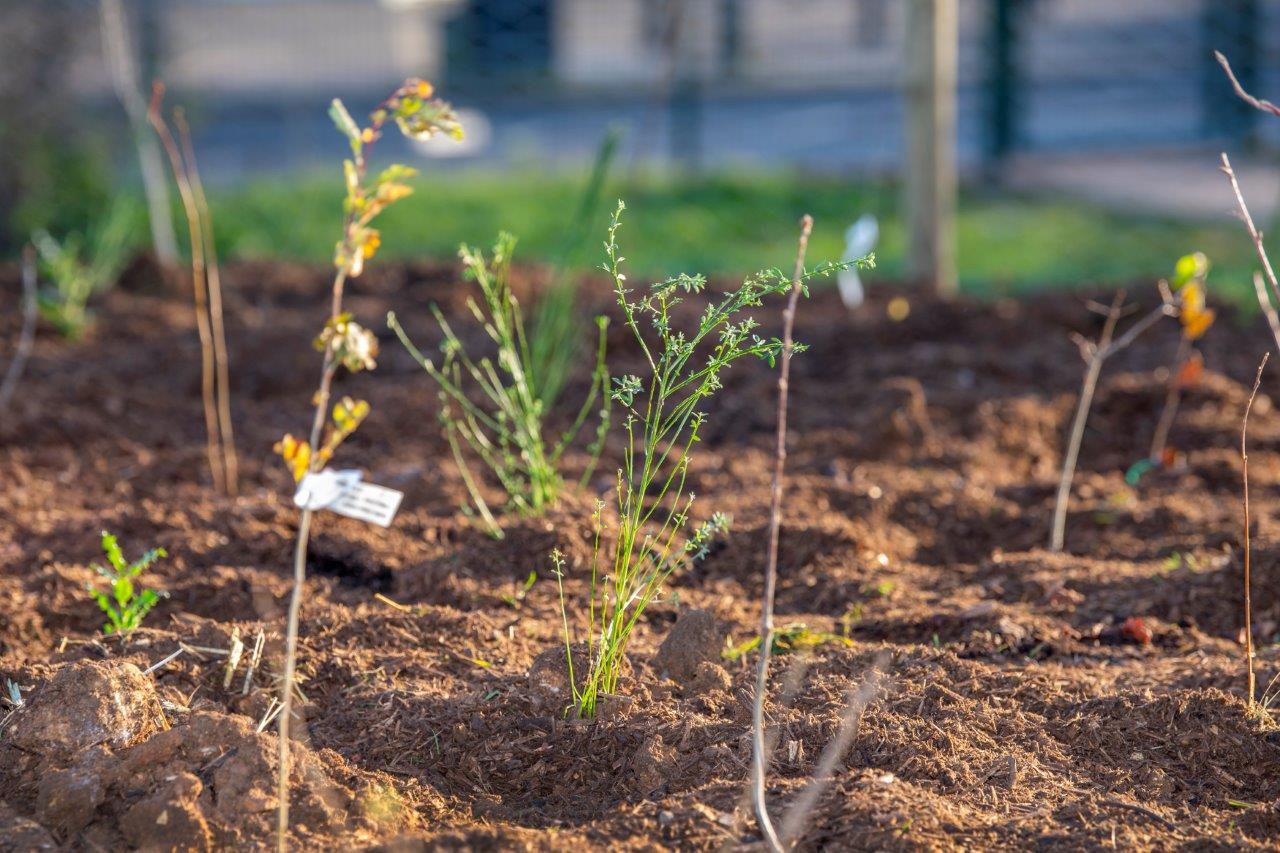
Teacher: The easiest way for me to undertake the project was to do it from my own classroom because I’m a full-time teacher. So we chose biodiversity and we used the night vision cameras. That was where it began. I picked that because it was more suited to the age of the children. It had to be something I could run in school time alongside everything else that we were doing.
How did you structure the activities?
Teacher: We got the children to understand what animals might visit the grounds at night. We made fact files about the animals. We predicted what we might see. The night vision cameras were set up in a specific area of the grounds. At the end we had an opening event where all the children came to that, and actually one of the nights when I was setting up the camera, a little girl came down with her mum to show her the area and tell her what we’d been doing.
What surprised you most?
Teacher: What surprised me was just the fact that the community, the parents are involved as well. Even when they hadn’t been directly involved, they start seeing the social media stuff. And there was one morning I was going out to go and put the camera down and this dad was like, oh, he’s told me all about this. Like, there was a fox, are you going to put it out again?
What have you taken from this experience?
Teacher: It’s given me a bit more confidence to sort of just get out and like use our school grounds. Realising how easy it was, I suppose, like it felt like a big project to undertake, but actually to get the kids out there, to get them involved, it took a little bit of planning, but it was actually not that difficult to sort of make it happen.
What happens next?
Teacher: We’re having an outdoor day in a couple of weeks actually with the idea that all the children on the same day from reception right up to year six are going to get outside and they’re going to be doing things like each year group can choose their own things. There’s scavenger hunts and bug hotels, but some of it just observing the nature. I’m also going to be rolling out some lessons for reception children around climate change next year because there isn’t really planning out there. I’m going to be doing something either half termly or termly that will roll out throughout the whole year.