The Autumn 2026 YORA newsletter is now available online here, and distributed to YORA members email inbox.
Categories
 Yorkshire Obesity Research Alliance
The Autumn 2026 YORA newsletter is now available online here, and distributed to YORA members email inbox.
The Summer 2026 YORA newsletter is now available online here, and distributed to YORA members email inbox.
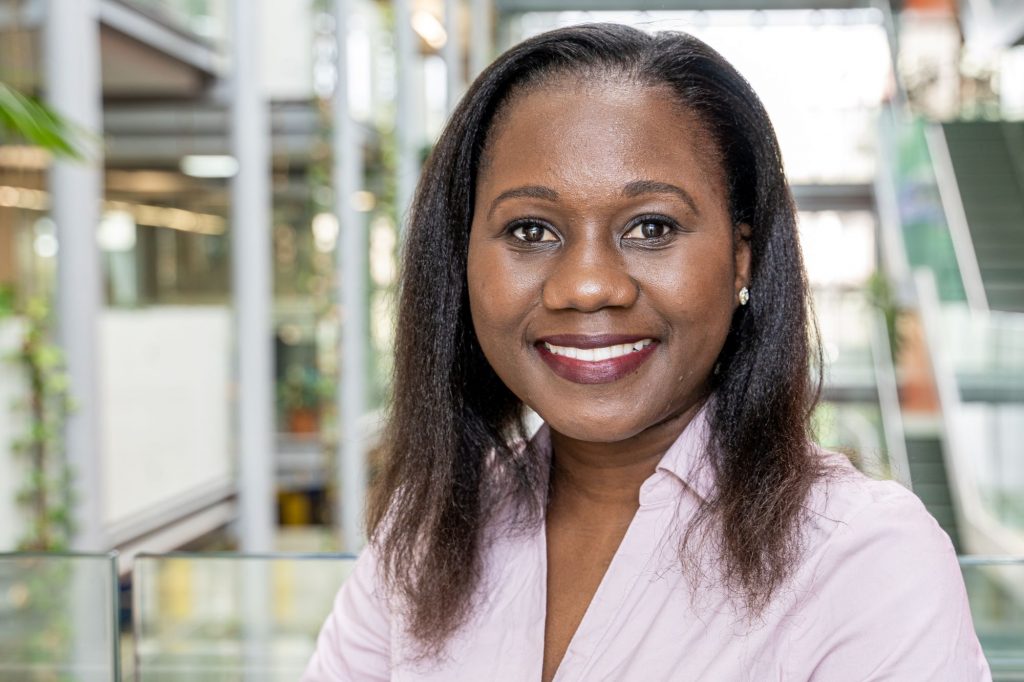
Tayamika Zabula is a health economist and Research Fellow in the Academic Unit of Health Economics at University of Leeds, where she joined in 2023. She completed her PhD in financial inclusion and applied microeconomics at the University of Leicester and has a background in applied economics with a focus on policy analysis and improving population wellbeing. Her work sits at the intersection of economics and health, with interests in development, poverty, and health systems. Tayamika’s research has more recently focused on weight management and obesity, contributing to projects across both adult and child populations. These include work on type 2 diabetes remission, the NHS Complications of Excess Weight (CEW) programme, and a ‘Cost of Cancer in the UK’ report. In this conversation, Tayamika shares insights into the role of health economics in weight management, and the challenges of evaluating and evidencing impact within real-world services.
Understanding the role of health economics
Describing her day-to-day work, Tayamika explained the deeply collaborative nature of health economics. Projects are rarely carried out in isolation, typically involving multidisciplinary teams and regular meetings and project updates. This is alongside the data analysis that forms the basis of the role.
“We’re usually involved on the data side of it and the data analysis, so we normally are the ones informing the rest of the team how the outcomes are looking, what type of people we have involved in our data demographics, and so on”
Tayamika pointed out that this means balancing different expectations. While clinicians and academics may be interested in one thing, commissioners may want evidence of value for money, which can create difficult conversations, particularly when the data does not align with expectations.
“We just want to tell the story of what’s in the data and it might not be what people want to hear”
Why obesity needs an economic lens
Tayamika emphasised the importance of looking at weight management through an economic lens.
“If we can deal with the root cause… then we’ll be able to help these people living with obesity to live better lives”
From a health economics perspective, the case for investment is not only about reducing future healthcare costs, but also about improving people’s quality of life. Intervening earlier may help prevent later complications and support better health and wellbeing in the present.
Tayamika discussed how demonstrating value is not straightforward. Decision-makers often need hard numbers for return on investment, but weight management services can be difficult to evaluate when outcomes unfold over long periods of time and available datasets are limited.
The challenge of proving long-term value
A major theme throughout our conversation was the tension between short-term decision-making and long-term benefit. Tayamika pointed out that commissioners may want to know what savings a service will generate, and when they will be seen, but those answers are far from straightforward.
Tayamika explained that while early signs may suggest that savings are likely, the available data often does not allow economists to show this with precision.
“We can see that there will be a saving, but we can’t tell you how much”
This can be especially challenging when deciding where to allocate limited resources. When the evidence cannot demonstrate a clear and immediate return, weight management services may struggle to compete with other areas of investment, even where the long-term case is strong.
Looking beyond weight
Another key issue raised was the emphasis often placed on weight itself, with Tayamika reflecting on the importance of considering broader outcomes too.
“They just want to see the weight”
Tayamika explained the other meaningful signs of success which might be seen in weight management, such as improved quality of life, self-esteem, school attendance, and reduced anxiety and depression. This is also where health economists offer a broader perspective- rather than looking solely at weight, economic evaluation often considers quality-adjusted life years (QALYs). QALYs capture whether people are living not just longer, but in better health.
“We want them to live those years in the best health possible”
QALYs look at mobility, self-care, usual activities, pain/discomfort, and anxiety/depression. Tayamika explained that an intervention may still be worthwhile if it improves quality of life, even if it does not drastically reduce weight.
Lessons for local authorities
When discussing interventions led by local authorities, Tayamika emphasised the importance of accessibility, equity, and practical support. Strategies such as ensuring support is close to home, reducing the need for long journeys, and offering flexibility around work hours were all highlighted as useful to reduce the cost for individuals.
For local authorities hoping to evaluate their own programmes, Tayamika suggested that it does not always need to be overly complex. She pointed out that even simple questionnaires administered at the beginning of a programme and at regular intervals can provide insights into whether improvements are happening.
“It might not be the best, but it will give them an indication of whether there’s improvements or not”
This highlights that while large-scale validated datasets are useful, practical local evaluation can begin with small, consistent steps.
Capturing wider impacts of interventions
Tayamika highlighted that weight management interventions often have wider effects than services immediately recognise. She explained that a programme may appear unsuccessful if judged on a narrow outcome, while in reality it may be generating positive changes elsewhere, for example with a child more confident in school. Similarly support provided to one person in a household may positively influence the habits and wellbeing of the whole household.
“We just look at the direct impacts, and we sort of ignore the indirect ones, which sometimes are just as large”
For Tayamika, this calls for a stronger collaboration between services and sectors. If local authorities, schools, health services and researchers were better linked, it might be easier to understand the full impact of interventions rather than judging them in isolation.
Addressing stigma in conversations about weight
The conversation also turned to stigma, particularly the risk that economic language around obesity can reinforce harmful public narratives. Headlines about the ‘cost’ of obesity can feed the misconception that obesity is an individual choice. Tayamika was clear in challenging this framing, stressing that obesity is shaped by a range of factors, including genetics, environment, and wider social conditions.
“People don’t choose to live with obesity”
For Tayamika, it is important to educate people about this while ensuring that person first language is used rather than reducing people to body size alone.
The role of lived experience
Although often seen as highly quantitative, Tayamika reflected on the importance of lived experience in health economics. Lived experience can help identify what matters most to people, what costs are being missed, and what outcomes should be measured. She described how patients and families often reveal hidden impacts that purely quantitative economic analyses might otherwise overlook, such as lost work hours, caring responsibilities, travel demands, and burden placed on households. These perspectives can help ensure that evaluations reflect what matters in real life, not just what is easiest to measure.
The role of researchers and clinicians
When asked what researchers and clinicians can do to strengthen the evidence base, Tayamika’s answer was simple: collect good quality data, and collect it consistently.
Without strong data, economists are limited in what they can show, and services are limited in what they can defend. Routine data collection can make it easier to evaluate impact, communicate value, and build stronger arguments for continued investment.
“The numbers can only speak for themselves if there are enough of them to tell a story”
Looking ahead
Tayamika emphasised the need for weight management services to be understood not only as a response to current health needs, but as an investment in future health, wellbeing, and wider social outcomes. The challenge now is ensuring that the systems used to evaluate these services are sufficiently broad, joined up, and robust to recognise their full value.
Written by Kaydee Shepherd, YORA Coordinator and PhD student at Leeds Beckett University.
The Spring 2026 YORA newsletter is now available online here, and distributed to YORA members email inbox.
See below PhD opportunities at Sheffield Hallam University:
🔬 Child Body Shape Phenotypes & Health Risk Prediction
Help transform how we understand and predict children’s health risks by developing new body shape phenotypes that go beyond traditional measures. https://www.findaphd.com/phds/project/transforming-lives-phd-scholarship-sheffield-hallam-university-child-body-shape-phenotypes-and-health-risk-prediction/?p194832
📏 Validating 3D Child Body Composition: Agreement, Bias, Equity & Correction
Work at the forefront of 3D imaging to evaluate accuracy, identify bias, and improve equity in child body composition assessment. https://www.findaphd.com/phds/project/transforming-lives-phd-scholarship-sheffield-hallam-university-validating-3d-child-body-composition-agreement-bias-equity-and-correction/?p194831
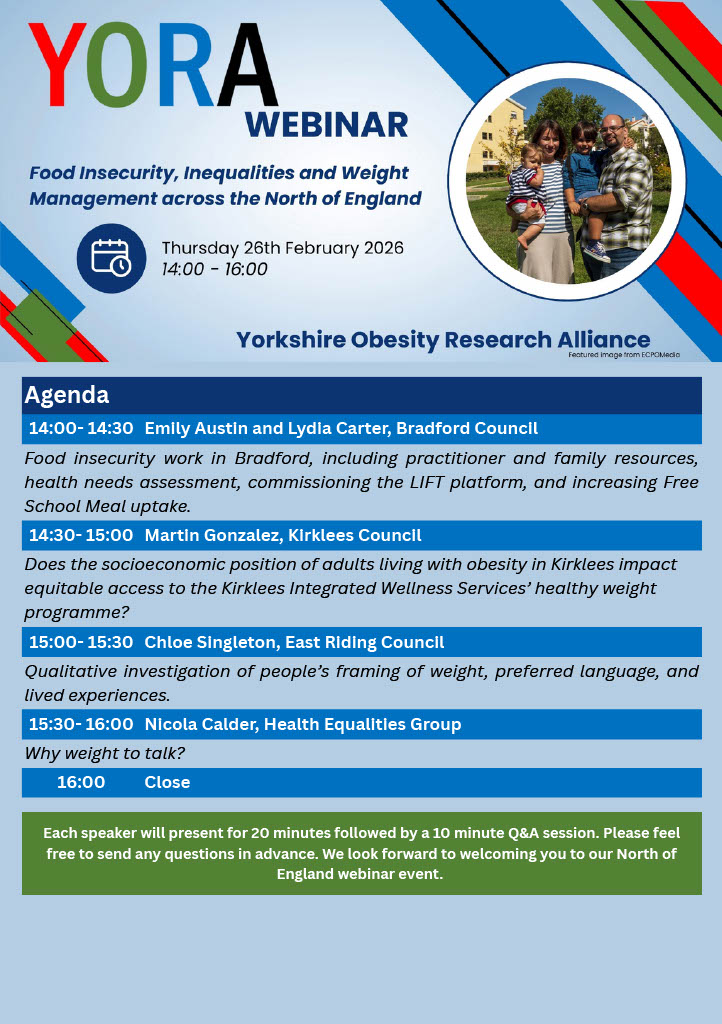
YORA Webinar – 26th February 2026, 14:00-16:00
Come join us online on 26th February 2026 for our Food Insecurity, Inequalities and Weight Management across the North of England webinar event. We welcome attendees from the public, academia, practice, and policy based across the North of England region- not just YORA members. To attend the YORA webinar, please register here.
The Winter 2026 YORA newsletter is now available online here, and distributed to YORA members email inbox.
The Autumn 2025 YORA newsletter is now available online here, and distributed to YORA members email inbox.
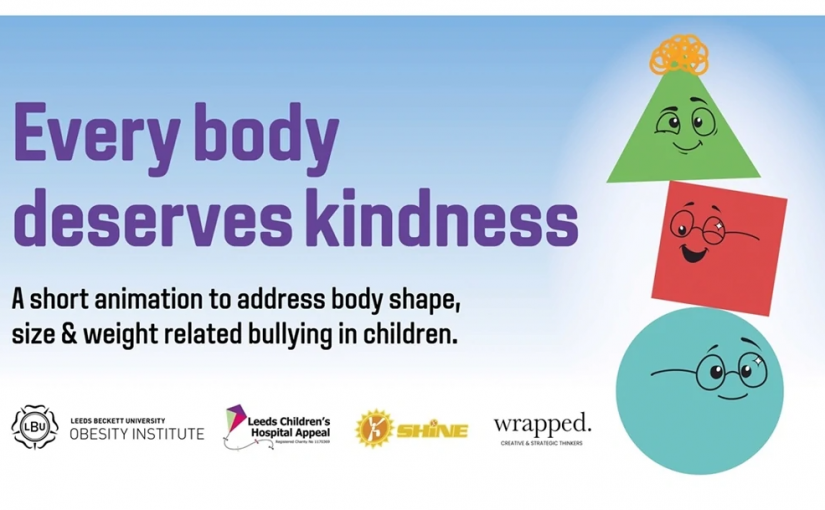
We are excited to introduce Every Body Deserves Kindness, a short film for children aged 6–9 designed to raise awareness of weight-related bullying while promoting kindness, inclusion, and positive body image.
The film was co-designed with young people, families, paediatricians, psychologists, child weight management experts, as well as primary school teachers and head teachers, ensuring it is both engaging and evidence-informed.
Alongside the film, we have developed a comprehensive teaching pack, aligned to PHSE for Key Stage 1 and 2. These resources are designed to support children in understanding, discussing, and challenging stigma and bias around body weight, shape, and size.
? Watch the film here.
?Click here for more information about the film and to download the free resource pack.
If you could spare a few minutes, we’d really appreciate your feedback on the resource pack. Please click here to answer a few questions. Thank you!
We hope these resources help create a more kind, inclusive, and body-positive environment in your community.
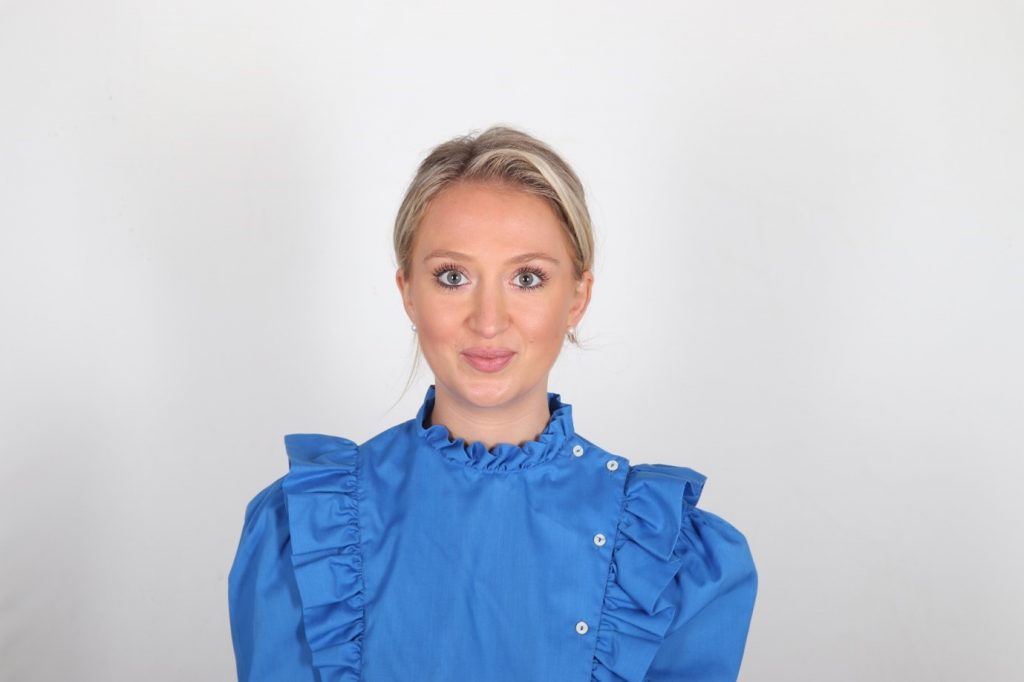
Dolly van Tulleken is a policy consultant and visiting researcher at the at Cambridge University’s MRC Epidemiology Unit where she completed her PhD and postdoctoral position specializing in government policy processes and the history of government policy on obesity and food-related ill health in England. Her research has been published in leading journals such as The Milbank Quarterly, BMJ Open, PLOS One, and Public Health Nutrition. Dolly’s expertise lies in analysing policy effectiveness and identifying the mechanisms that drive meaningful public health change. In 2024, she co-authored Nourishing Britain: A Political Manual for Improving the Nation’s Health with Henry Dimbleby, which contained practical political insights about food-related health policy from 20 prime ministers, health secretaries and other senior politicians. In this conversation, Dr. Dolly van Tulleken shared with us her journey through academia, policymaking, and consultancy, focusing on driving meaningful change in the food system.
Bridging Academia and Policy
Dr. van Tulleken highlights how her PhD research examining decades of proposed government obesity policies led her to feel a strong urgency to help effect real-world change. This prompted her return to the policy world, where she founded Dolitics, a consultancy aimed at supporting evidence-based policy change. Whilst working mostly with charity clients in her consultancy role, Dr. van Tulleken is also involved in research, remaining a visiting researcher at the MRC epidemiology unit in Cambridge. When summing up her role, Dr. van Tulleken termed herself an information broker with the aim of progressing policy. “Most of my work is about how to actually try and support policy change to happen and that’s done through all sorts of different ways; research collaboration, liaising with policymakers, building up networks”.
The Power of Multidisciplinary Collaboration
While acknowledging the challenges of working across sectors and disciplines, Dr. van Tulleken emphasises that impactful change requires collective effort, sharing her motto- “nothing worth achieving can be achieved alone”. The expertise in her work, she points out, “is almost knowing who to collaborate with and learn from and where the interesting work is happening”, then being able to bring the best people together.
Translating Research into Practice
Drawing from her co-authored 2023 report, Nourishing Britain: A Political Manual for Improving the Nation’s Health, she reflects on the use of research as a tool for practical action. The manual is based on interviews with 20 senior political figures and offers guidance to future leaders on overcoming barriers to food policy reform. Dr. van Tulleken explains “the whole point was to give the manual to today’s politicians and tomorrow’s politicians and say ‘these are the sorts of challenges your predecessors say you’re very likely to face, and this is how to get over them’”.
Advice for Early-Career Researchers and Advocates
For those hoping to make an impact on obesity policy, Dr. van Tulleken encourages leaning into your strengths, embracing collaboration, and doing work that you love. She urges people not to limit themselves- whether by standing for local office, contributing to campaigns, or simply making valuable research more accessible to those in power.
Her advice includes:
Where Policymakers Can Start
When asked how local authorities might begin addressing obesity, Dr. van Tulleken underscores the value of local action whilst recognising “lots of things need to happen all at once in order for change to be made”. She again points to the importance of building connections, citing an example of one man on a mission to create a localised food system. “He was building up these personal connections to see whether there could be better distribution networks, more localised systems, whether retailers would be able to have better connections with local farmers”. Dr. van Tulleken sees local authorities having an enormous amount of power, referring to examples such as banning junk food advertising on public transport and building local food networks as effective grassroots strategies. She also points to the Scottish Good Food Nation Act as a promising model for long-term, localised food planning.
Navigating Weight Stigma
When asked about how we can avoid the trap of individual blame and stigma around weight, Dr. van Tulleken shares her frustrations with the food system being a “primary driver of health problems”. She points out “the cards are stacked against everyone to enjoy a healthy life, which I think is completely ludicrous”.
“The more attention is on the food system and on the large corporations that are benefitting the most from this system, the more we move away from the blame on the individual and we understand that we’re actually all operating in this system”.
This pressure on those who are benefiting from the system, she notes, is how we can move away from stigma and shame, and allow people to recognise that “their health, their eating, food, weight, whatever- it usually all links to the food system that we’re in”.
Dr. van Tulleken recognises that “even talking about it, even when trying to counter against stigma, shame and blame, it can be really hard”. When telling people she works in food policy, people respond with ‘oh no don’t look at what I’m eating’, or ‘don’t judge me for my lunch’.
“You’ve still got this notion that you’re there judging, and I think it’s a really important responsibility of people working in this space to actively be aware of that and how we can communicate in a way that shows this is about making sure everyone can enjoy a nourishing diet and have affordable access to that”.
The biggest gaps in Obesity Research
When asked about pressing research priorities, Dr. van Tulleken highlights that there is very little activity in what a sustainable, health-promoting food system could actually look like- especially at the local level. She urges researchers and policymakers to not only study this, but to experiment, prototype, and learn by doing.
“You have to kind of experiment- it really takes innovation, experimentation, confidence and risk by policy makers and researchers in this space to just try things. Monitor it, see what works, see what doesn’t work, but with the ambition of going how can we make a nourishing food system commercially viable?”
Local authorities, she says, are well-positioned to pilot these innovations despite limited resources, and she sees promise in Scotland’s Good Food Nation Act, which mandates government-backed local food planning.
Challenges and Joys of the Work
Finding non-conflicting funding not tied to powerful food corporations emerges as the biggest barrier for Dr. van Tulleken in her work. “If you have very strict rules about where you get funding from, the pots that are available are very limited”. Though she does note that policy-backed initiatives like Scotland’s Good Food Nation Act may signal progress.
On a more positive note, she enjoys the clarity and purpose in her day-to-day work and the joy of collaborating with passionate colleagues, including family members-something she sees as a unique privilege.
What’s Next
Looking ahead, Dr. van Tulleken hopes to continue conducting deep-dive research while improving how findings are communicated. “Filling in the gaps of the research that we need to continue making happen, with no excuses for that being a reason for inaction”.
Her long-term vision includes encouraging more people to become change makers- especially those motivated by food justice and public health.
“If I can see more and more people getting elected who are primarily in politics for food and health, that would be an incredible achievement.”
Link to Dolitics: https://dolitics.co.uk/home
Written by Kaydee Shepherd, YORA Coordinator and PhD student at Leeds Beckett University.