The Autumn 2026 YORA newsletter is now available online here, and distributed to YORA members email inbox.
Categories
 Yorkshire Obesity Research Alliance
The Autumn 2026 YORA newsletter is now available online here, and distributed to YORA members email inbox.
The Summer 2026 YORA newsletter is now available online here, and distributed to YORA members email inbox.
Tayamika Zabula is a health economist and Research Fellow in the Academic Unit of Health Economics at University of Leeds, where she joined in 2023. She completed her PhD in financial inclusion and applied microeconomics at the University of Leicester and has a background in applied economics with a focus on policy analysis and improving population wellbeing. Her work sits at the intersection of economics and health, with interests in development, poverty, and health systems. Tayamika’s research has more recently focused on weight management and obesity, contributing to projects across both adult and child populations. These include work on type 2 diabetes remission, the NHS Complications of Excess Weight (CEW) programme, and a ‘Cost of Cancer in the UK’ report. In this conversation, Tayamika shares insights into the role of health economics in weight management, and the challenges of evaluating and evidencing impact within real-world services.

Understanding the role of health economics
Describing her day-to-day work, Tayamika explained the deeply collaborative nature of health economics. Projects are rarely carried out in isolation, typically involving multidisciplinary teams and regular meetings and project updates. This is alongside the data analysis that forms the basis of the role.
“We’re usually involved on the data side of it and the data analysis, so we normally are the ones informing the rest of the team how the outcomes are looking, what type of people we have involved in our data demographics, and so on”
Tayamika pointed out that this means balancing different expectations. While clinicians and academics may be interested in one thing, commissioners may want evidence of value for money, which can create difficult conversations, particularly when the data does not align with expectations.
“We just want to tell the story of what’s in the data and it might not be what people want to hear”
Why obesity needs an economic lens
Tayamika emphasised the importance of looking at weight management through an economic lens.
“If we can deal with the root cause… then we’ll be able to help these people living with obesity to live better lives”
From a health economics perspective, the case for investment is not only about reducing future healthcare costs, but also about improving people’s quality of life. Intervening earlier may help prevent later complications and support better health and wellbeing in the present.
Tayamika discussed how demonstrating value is not straightforward. Decision-makers often need hard numbers for return on investment, but weight management services can be difficult to evaluate when outcomes unfold over long periods of time and available datasets are limited.
The challenge of proving long-term value
A major theme throughout our conversation was the tension between short-term decision-making and long-term benefit. Tayamika pointed out that commissioners may want to know what savings a service will generate, and when they will be seen, but those answers are far from straightforward.
Tayamika explained that while early signs may suggest that savings are likely, the available data often does not allow economists to show this with precision.
“We can see that there will be a saving, but we can’t tell you how much”
This can be especially challenging when deciding where to allocate limited resources. When the evidence cannot demonstrate a clear and immediate return, weight management services may struggle to compete with other areas of investment, even where the long-term case is strong.
Looking beyond weight
Another key issue raised was the emphasis often placed on weight itself, with Tayamika reflecting on the importance of considering broader outcomes too.
“They just want to see the weight”
Tayamika explained the other meaningful signs of success which might be seen in weight management, such as improved quality of life, self-esteem, school attendance, and reduced anxiety and depression. This is also where health economists offer a broader perspective- rather than looking solely at weight, economic evaluation often considers quality-adjusted life years (QALYs). QALYs capture whether people are living not just longer, but in better health.
“We want them to live those years in the best health possible”
QALYs look at mobility, self-care, usual activities, pain/discomfort, and anxiety/depression. Tayamika explained that an intervention may still be worthwhile if it improves quality of life, even if it does not drastically reduce weight.
Lessons for local authorities
When discussing interventions led by local authorities, Tayamika emphasised the importance of accessibility, equity, and practical support. Strategies such as ensuring support is close to home, reducing the need for long journeys, and offering flexibility around work hours were all highlighted as useful to reduce the cost for individuals.
For local authorities hoping to evaluate their own programmes, Tayamika suggested that it does not always need to be overly complex. She pointed out that even simple questionnaires administered at the beginning of a programme and at regular intervals can provide insights into whether improvements are happening.
“It might not be the best, but it will give them an indication of whether there’s improvements or not”
This highlights that while large-scale validated datasets are useful, practical local evaluation can begin with small, consistent steps.
Capturing wider impacts of interventions
Tayamika highlighted that weight management interventions often have wider effects than services immediately recognise. She explained that a programme may appear unsuccessful if judged on a narrow outcome, while in reality it may be generating positive changes elsewhere, for example with a child more confident in school. Similarly support provided to one person in a household may positively influence the habits and wellbeing of the whole household.
“We just look at the direct impacts, and we sort of ignore the indirect ones, which sometimes are just as large”
For Tayamika, this calls for a stronger collaboration between services and sectors. If local authorities, schools, health services and researchers were better linked, it might be easier to understand the full impact of interventions rather than judging them in isolation.
Addressing stigma in conversations about weight
The conversation also turned to stigma, particularly the risk that economic language around obesity can reinforce harmful public narratives. Headlines about the ‘cost’ of obesity can feed the misconception that obesity is an individual choice. Tayamika was clear in challenging this framing, stressing that obesity is shaped by a range of factors, including genetics, environment, and wider social conditions.
“People don’t choose to live with obesity”
For Tayamika, it is important to educate people about this while ensuring that person first language is used rather than reducing people to body size alone.
The role of lived experience
Although often seen as highly quantitative, Tayamika reflected on the importance of lived experience in health economics. Lived experience can help identify what matters most to people, what costs are being missed, and what outcomes should be measured. She described how patients and families often reveal hidden impacts that purely quantitative economic analyses might otherwise overlook, such as lost work hours, caring responsibilities, travel demands, and burden placed on households. These perspectives can help ensure that evaluations reflect what matters in real life, not just what is easiest to measure.
The role of researchers and clinicians
When asked what researchers and clinicians can do to strengthen the evidence base, Tayamika’s answer was simple: collect good quality data, and collect it consistently.
Without strong data, economists are limited in what they can show, and services are limited in what they can defend. Routine data collection can make it easier to evaluate impact, communicate value, and build stronger arguments for continued investment.
“The numbers can only speak for themselves if there are enough of them to tell a story”
Looking ahead
Tayamika emphasised the need for weight management services to be understood not only as a response to current health needs, but as an investment in future health, wellbeing, and wider social outcomes. The challenge now is ensuring that the systems used to evaluate these services are sufficiently broad, joined up, and robust to recognise their full value.
Written by Kaydee Shepherd, YORA Coordinator and PhD student at Leeds Beckett University.
The Spring 2026 YORA newsletter is now available online here, and distributed to YORA members email inbox.
See below PhD opportunities at Sheffield Hallam University:
🔬 Child Body Shape Phenotypes & Health Risk Prediction
Help transform how we understand and predict children’s health risks by developing new body shape phenotypes that go beyond traditional measures. https://www.findaphd.com/phds/project/transforming-lives-phd-scholarship-sheffield-hallam-university-child-body-shape-phenotypes-and-health-risk-prediction/?p194832
📏 Validating 3D Child Body Composition: Agreement, Bias, Equity & Correction
Work at the forefront of 3D imaging to evaluate accuracy, identify bias, and improve equity in child body composition assessment. https://www.findaphd.com/phds/project/transforming-lives-phd-scholarship-sheffield-hallam-university-validating-3d-child-body-composition-agreement-bias-equity-and-correction/?p194831
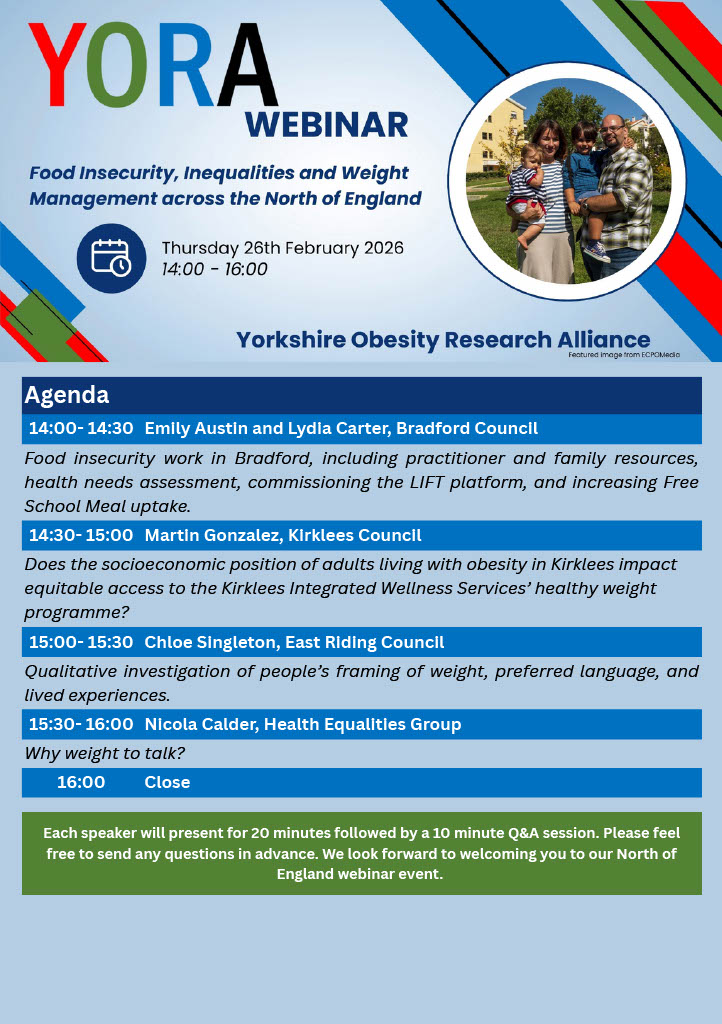
YORA Webinar – 26th February 2026, 14:00-16:00
Come join us online on 26th February 2026 for our Food Insecurity, Inequalities and Weight Management across the North of England webinar event. We welcome attendees from the public, academia, practice, and policy based across the North of England region- not just YORA members. To attend the YORA webinar, please register here.
The Winter 2026 YORA newsletter is now available online here, and distributed to YORA members email inbox.