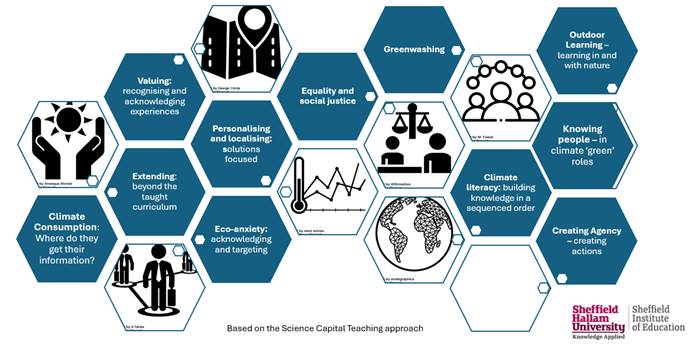
The RICE framework, developed by academics at Sheffield Hallam University, supports high-quality climate education by building climate knowledge (what students understand), motivation (why they care), and agency (what they feel able to do). The framework builds on the Science Capital Teaching Approach. The framework broadly covers eleven themes:
- Climate Literacy – structured, age-appropriate knowledge that builds understanding over time
Valuing – recognising students’ existing experiences and connecting to new learning Personalising and localising – grounding climate in local, actionable contexts - Extending beyond taught curriculum – learning through clubs, projects, communities Climate Consumption – critical thinking about where climate information comes from
- Eco-anxiety – explicitly addressing fear and worry, turning it into constructive action
- Equality and social justice – understanding who climate change affects most Greenwashing – teaching students to critically evaluate climate claims
- Knowing people in climate ‘green’ roles – exposure to real climate careers and pathways
- Creating Agency – empowering students to act at individual, school, and community levels
- Outdoor Learning – direct experience in natural environments for deeper understanding and connection
Several recent projects delivered by Sheffield Hallam University have used utilised the framework to develop and deliver teacher CPD and curriculum programmes, including:
- Adapt-Ed (2025-ending in 2027) – funded by MACC
- Project in a Box – Think Climate! (2024-2025) funded by Sheffield Hallam University
- Tomorrow’s Climate Scientists (2024-2026) funded by the Royal Society
Each component plays a distinct but interconnected role:
1. Climate Literacy (sequenced knowledge)
Why it matters:
A structured, age-appropriate progression of climate knowledge ensures students build accurate understanding over time – avoiding misconceptions and fragmentation.
- Knowledge: Develops core scientific and socio-ecological understanding
- Motivation: Reduces confusion and overwhelm
- Agency: Enables informed decision-making
2. Valuing: recognising and acknowledging experiences
Why it matters:
Students come with existing experiences of weather, environment, and climate. Recognising these validates identity and supports inclusion.
- Knowledge: Connects prior knowledge to new learning
- Motivation: Builds relevance and belonging
- Agency: Encourages participation and voice
3. Personalising and localising (solutions-focused)
Why it matters:
Grounding climate change in local contexts makes it tangible and actionable.
- Knowledge: Links global concepts to lived realities
- Motivation: Increases perceived relevance
- Agency: Highlights realistic, place-based actions
4. Extending beyond the taught curriculum
Why it matters:
Climate learning happens beyond lessons – through clubs, projects, communities, and informal learning.
- Knowledge: Deepens and broadens understanding
- Motivation: Sustains engagement over time
- Agency: Provides real-world opportunities to act
5. Climate Consumption (where do they get their information?)
Why it matters:
Students are exposed to climate narratives through media and social platforms, which can shape understanding and attitudes.
- Knowledge: Develops critical media literacy
- Motivation: Counters misinformation and apathy
- Agency: Empowers informed judgement and dialogue
6. Eco-anxiety: acknowledging and targeting
Why it matters:
Climate change can provoke anxiety, fear, or helplessness. Addressing this explicitly is essential for wellbeing and engagement.
- Knowledge: Helps interpret risks appropriately
- Motivation: Prevents disengagement or denial
- Agency: Reframes concern into constructive action
7. Equality and social justice
Why it matters:
Climate change is unevenly experienced. Understanding justice dimensions fosters ethical and global awareness.
- Knowledge: Builds understanding of inequalities and impacts
- Motivation: Strengthens moral purpose
- Agency: Encourages advocacy and fairness-oriented action
8. Greenwashing
Why it matters:
Students need to critically evaluate claims made by organisations, governments, and media.
- Knowledge: Develops critical thinking and scrutiny
- Motivation: Builds trust in credible solutions
- Agency: Supports informed choices and accountability
9. Knowing people in climate ‘green’ roles
Why it matters:
Exposure to real people working in climate-related roles expands horizons and challenges stereotypes.
- Knowledge: Increases awareness of pathways and careers
- Motivation: Builds aspiration and relevance
- Agency: Helps students see themselves as future contributors
10. Creating Agency (taking action)
Why it matters:
Ultimately, climate education should empower students to act meaningfully at individual, school, and community levels.
- Knowledge: Applies learning in practical contexts
- Motivation: Reinforces purpose and efficacy
- Agency: Builds confidence to make change happen
11. Outdoor Learning (learning with and in nature)
Why it matters:
Direct experiences in natural environments deepen understanding, strengthen emotional connections, and make climate and sustainability learning tangible rather than abstract.
- Knowledge: Enhances understanding of ecosystems, biodiversity, and environmental processes through real-world observation
- Motivation: Builds connection to nature (linked to measures like Connectedness to Nature), increasing care and concern
- Agency: Encourages stewardship behaviours and empowers students to take action in their immediate environment
Bringing it together
The strength of RICE lies in its integration:
- Knowledge is built through structured, contextualised learning
- Motivation is fostered through relevance, justice, and emotional engagement
- Agency is developed through opportunities to act, reflect, and see impact
Together, these elements move climate education beyond awareness – towards informed, empowered, and active learners.