



Welcome!
The five-year Allied Health Professions Workforce Research Partnership (AHP WRaP) aims to improve patient care by ensuring staff in allied health roles – such as paramedics, physiotherapists and radiographers – have the right skills and are available when and where they are needed in NHS hospitals, community services, and general practice.
Our partnership brings together individuals and organisations from across disciplines and sectors in three regional workforce research hubs to deliver prioritised AHP workforce research using participatory approaches. The partnership is led by Sheffield Hallam University (PI Professor Julie Nightingale) with partners at Anglia Ruskin University, the University of Suffolk, University of Lincoln, University of Sheffield, and NHS East of England.
Recent Updates
-

Newsletter #2 – July 2026
We’re pleased to share the latest newsletter from the AHP WRaP programme, highlighting recent progress, key insights, and ongoing research activity. This edition showcases the Top 10 research priorities for AHP workforce research – a key output from the first phase of or partnership.
-
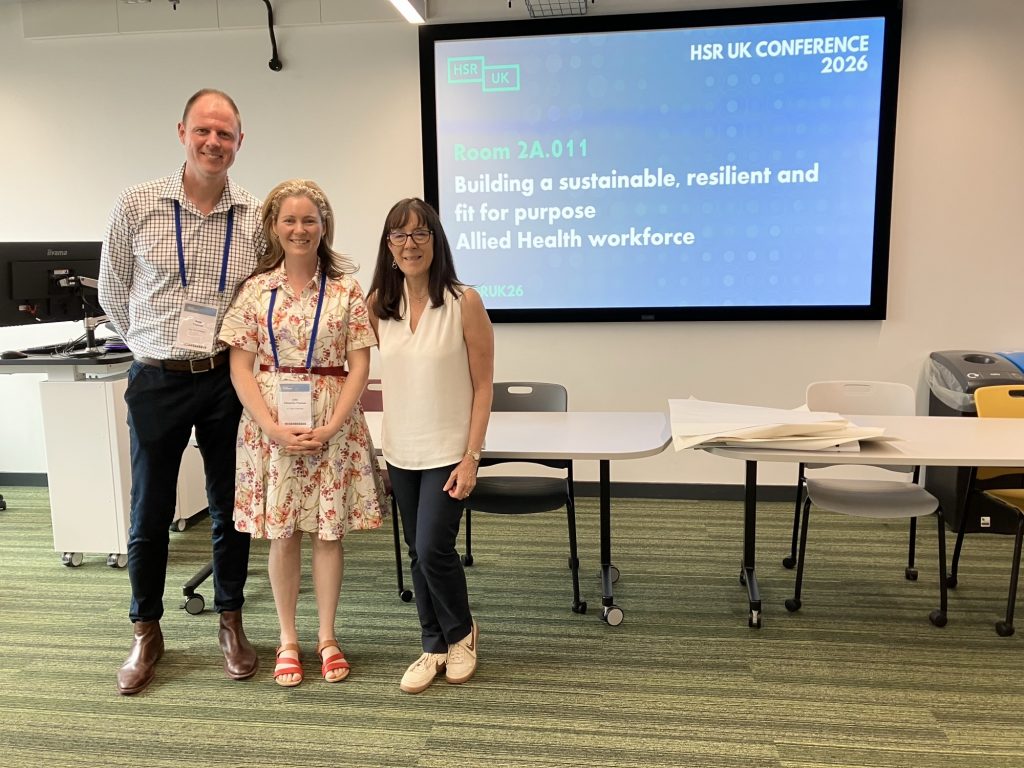
Health Services Research UK (HSR UK) Conference
AHP WRaP had strong representation across the conference programme, with several colleagues presenting their latest research: Dr Maria Wishart ‘Sustaining the rural & coastal Allied Health Professional workforce’ Dr Gupteswar Patel ‘Examining the system‑ and service‑levelimpacts of Level 6 AHP apprenticeships in England: amixed‑methods study’ Dr Tanja Kleinhappel ‘Patterns and workforce contribution ofLevel 6 AHP…
-

PSP Prioritisation Survey Launch
The AHP Workforce PSP aims to work with the UK AHP workforce, along with representatives of the people and communities accessing their services, to identify the most important unanswered questions about the AHP workforce. The scope of the AHP Workforce PSP is defined as: any aspects of the UK AHP workforce, including but not limited…
-
Newsletter #1 – March 2026
We’re pleased to share the latest newsletter from the AHP WRaP programme, highlighting recent progress, key insights, and ongoing research activity. This edition showcases the collaborative work taking place across the project and reflects our continued commitment to advancing knowledge and practice. We invite you to explore the updates and stay connected with our journey.

Prof Julie Nightingale
Programme Director, AHP WRaP
“The NHS is facing a shortage of allied health professionals, particularly in rural and coastal areas where attracting and retaining staff is especially challenging. As a result, some patients struggle to access vital services such as scans, cancer treatment, and rehabilitation. Our research is essential to understand the problem so we can help the NHS address the staffing crisis and improve patient care.”
Community of Partnerships
AHP WRaP is one of five workforce research partnerships funded by HSDR. All are focused on different issues for the workforce across the health and care system, and collectively we will be building a comprehensive programme of work to address workforce challenges in coming years.
Adult Social Care Workforce Research Partnership
The Adult Social Care Workforce Partnership led by Prof Ann-Marie Towers at the Kings College London, and Prof Karen Spilsbury at the University of Leeds.
CARES-Well
Innovative partnerships to enable staff to care well under pressure and thrive at work. Led by Prof Cath Taylor and Prof Jill Maben at the University of Surrey.

SURGE
The Same Day and Urgent Care Workforce Research Partnership (SURGE). Led by Professor Sarah Voss at the University of the West of England.

Workforce Voices
Workforce Voices is led by Professor Gill Vance and Dr Bryan Burford at Newcastle University.