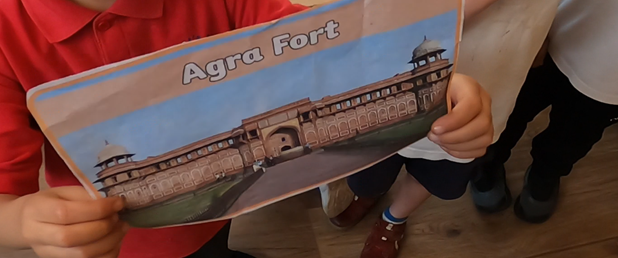
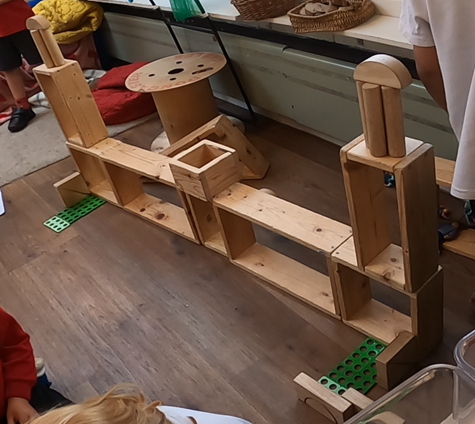
In this blog post I reflect on a transcription of an episode from my ECRIF project. This particular episode took place in the Reception classroom in one of the schools where the research took place (data collected on 18th June 2025). As part of a week of engaging in ‘Indian themed activities’ a group of three boys chose to build a replica of the Agra Fort. The Agra Fort is a 16th Century historical fort remaining from the Mughal Empire. Its significance during the Mughal Empire period has contributed to its current status as a UNESCO World Heritage Site.
As a reminder this ECRIF research project is focussed on understanding and valuing the ways in which children make use of their full communicative repertoire and bring multiple modalities into their communication. This communicative repertoire orientation could include different languages, but also multiple modes of communication such as gesture, movement, vocalisation, gaze. In line with this I produced a multimodal conversation analysis transcript (Mondada, 2018) which captured not only speech but also the children’s embodied interactions. A few of my reflections on the video extract are captured below.
Gesture and temporality as orchestrating the filming
The children became aware of me filming their build and after having some conversations with me about why I was filming and what the camera does, they proceeded to build while remaining aware of my presence. They gradually began to signal to me, mostly through gesture, when I should film and when I should pause the recording, as well as where and on which features of the build I should direct the camera, which I obliged. I felt that this changed the dynamic of researcher and participants, making my filming not so much a data collection instance as a child-orchestrated documenting of the features of their build which the children chose to show and communicate about. In a way the children seized control of the camera, directing when I should pause and restart filming and what I should focus the filming on.
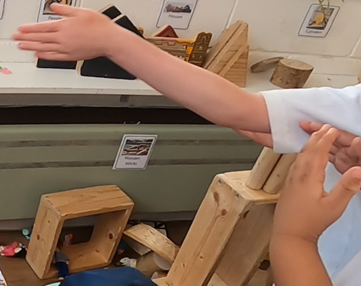
The multimodal transcript shows how the children built in pausing and restarting of the filming, depending on when they felt ready to communicate another feature of the build. This added a temporal dimension to the communication which was mostly communicated through gesture (often putting their palm up to the camera, whispering ‘pause, pause’, or standing up facing the camera when ready to share). I felt that using gesture combined with temporally orchestrating the communication enables children to feel more in control of how and what was communicated.
This in my view also has some implications for how we think about oracy and performative talk in the early childhood classroom. In an earlier paper on dialogic teaching with year 6 children (Ehiyazaryan-White, 2025) I explored how children used ‘talk as performance’ space in the curriculum to communicate in low key, informal ways which enabled them to take ownership of the communicative interaction and in the process show enjoyment of talk as well as make use of broader linguistic and register choices.
In this early childhood context, where talk is emerging and communication is notably embodied (Flewitt et al., 2026), the use of gesture and opportunity to temporally organise the interaction are foregrounded and enable children to take control of the interaction. The talk as performance aspect described in literature by the Oracy Commission is contextualised here not as a formal, teacher directed presentation (characteristic of in the reception classroom for example in ‘show and tell’ activities) but as a gesturally and temporally orchestrated and materially situated sequence, which in this case was child owned and initiated.
Noticing and valuing multiple modalities in children’s communication is key here in understanding what performative talk could mean in early childhood and how children embody and orchestrate such talk.
References:
Ehiyazaryan-White, E. (2025). Exploring opportunities for dialogic teaching within the genre pedagogy teaching and learning cycle in primary classrooms. Language and Education, 39(6), 1357–1377. https://doi.org/10.1080/09500782.2025.2504462
Flewitt, R., Holmes, R., & MacRae, C. (2026). Language as bodily and material. In K. Badwan, R. Churchill Dower, W. Farah, R. Flewitt, A. Hackett, R. Holmes, C. MacRae, V. Nair & D. B. Shannon (Eds.), Language, place and the body in childhood literacies: theory, practice and social justice (pp. 19–31). Routledge. https://10.4324/9781032677927-4
Mondada, L. (2018). Multiple Temporalities of Language and Body in Interaction: Challenges for Transcribing Multimodality. Research on Language and Social Interaction, 51(1), 85–106. https://10.1080/08351813.2018.1413878