Children’s gestural and temporal orchestrating of the building of the Agra Fort

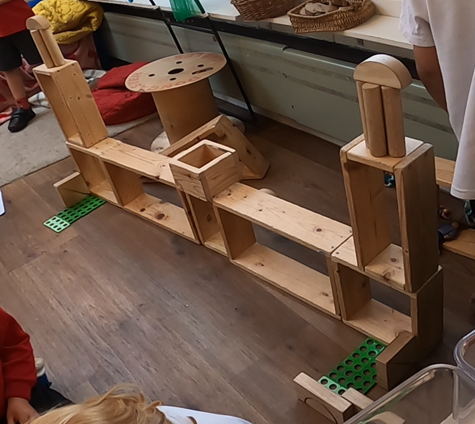
In this blog post I reflect on a transcription of an episode from my ECRIF project. This particular episode took place in the Reception classroom in one of the schools where the research took place (data collected on 18th June 2025). As part of a week of engaging in ‘Indian themed activities’ a group of three boys chose to build a replica of the Agra Fort. The Agra Fort is a 16th Century historical fort remaining from the Mughal Empire. Its significance during the Mughal Empire period has contributed to its current status as a UNESCO World Heritage Site.  
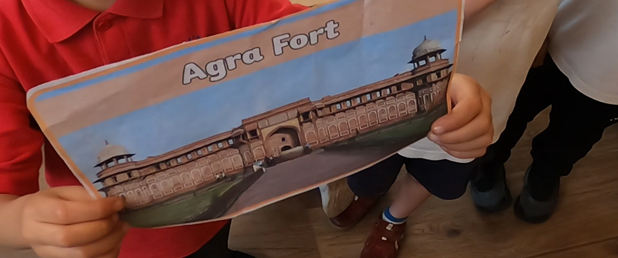
As a reminder this ECRIF research project is focussed on understanding and valuing the ways in which children make use of their full communicative repertoire and bring multiple modalities into their communication. This communicative repertoire orientation could include different languages, but also multiple modes of communication such as gesture, movement, vocalisation, gaze. In line with this I produced a multimodal conversation analysis transcript (Mondada, 2018) which captured not only speech but also the children’s embodied interactions. A few of my reflections on the video extract are captured below.

Gesture and temporality as orchestrating the filming

The children became aware of me filming their build and after having some conversations with me about why I was filming and what the camera does, they proceeded to build while remaining aware of my presence. They gradually began to signal to me, mostly through gesture, when I should film and when I should pause the recording, as well as where and on which features of the build I should direct the camera, which I obliged. I felt that this changed the dynamic of researcher and participants, making my filming not so much a data collection instance as a child-orchestrated documenting of the features of their build which the children chose to show and communicate about. In a way the children seized control of the camera, directing when I should pause and restart filming and what I should focus the filming on.
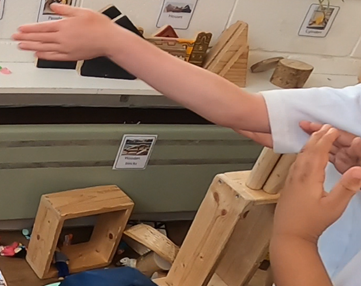
The multimodal transcript shows how the children built in pausing and restarting of the filming, depending on when they felt ready to communicate another feature of the build. This added a temporal dimension to the communication which was mostly communicated through gesture (often putting their palm up to the camera, whispering ‘pause, pause’, or standing up facing the camera when ready to share). I felt that using gesture combined with temporally orchestrating the communication enables children to feel more in control of how and what was communicated.

This in my view also has some implications for how we think about oracy and performative talk in the early childhood classroom. In an earlier paper on dialogic teaching with year 6 children (Ehiyazaryan-White, 2025) I explored how children used ‘talk as performance’ space in the curriculum to communicate in low key, informal ways which enabled them to take ownership of the communicative interaction and in the process show enjoyment of talk as well as make use of broader linguistic and register choices.

In this early childhood context, where talk is emerging and communication is notably embodied (Flewitt et al., 2026), the use of gesture and opportunity to temporally organise the interaction are foregrounded and enable children to take control of the interaction. The talk as performance aspect described in literature by the Oracy Commission is contextualised here not as a formal, teacher directed presentation (characteristic of in the reception classroom for example in ‘show and tell’ activities) but as a gesturally and temporally orchestrated and materially situated sequence, which in this case was child owned and initiated.

Noticing and valuing multiple modalities in children’s communication is key here in understanding what performative talk could mean in early childhood and how children embody and orchestrate such talk.
References:

Ehiyazaryan-White, E. (2025). Exploring opportunities for dialogic teaching within the genre pedagogy teaching and learning cycle in primary classrooms. Language and Education39(6), 1357–1377. https://doi.org/10.1080/09500782.2025.2504462

Flewitt, R., Holmes, R., & MacRae, C. (2026). Language as bodily and material. In K. Badwan, R. Churchill Dower, W. Farah, R. Flewitt, A. Hackett, R. Holmes, C. MacRae, V. Nair & D. B. Shannon (Eds.), Language, place and the body in childhood literacies: theory, practice and social justice (pp. 19–31). Routledge. https://10.4324/9781032677927-4

Mondada, L. (2018). Multiple Temporalities of Language and Body in Interaction: Challenges for Transcribing Multimodality. Research on Language and Social Interaction, 51(1), 85–106. https://10.1080/08351813.2018.1413878
Reflections on Multilingual Comic Making ESRC Festival of Social Science event

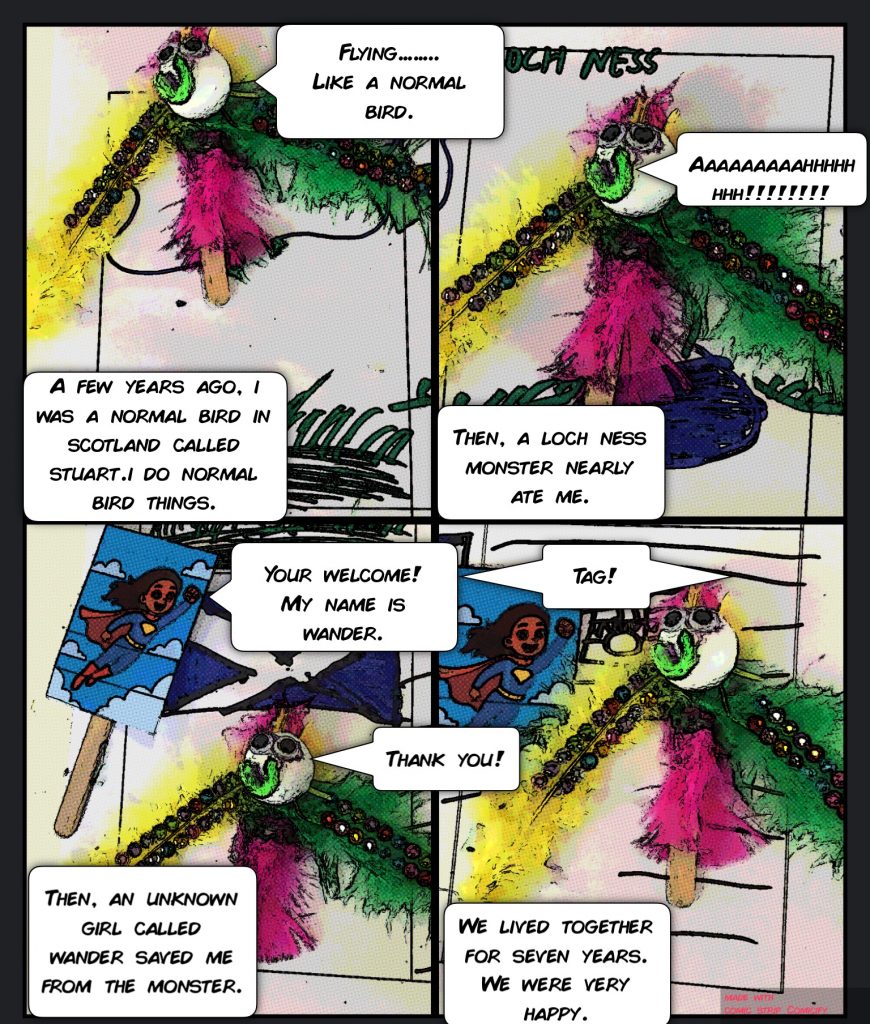
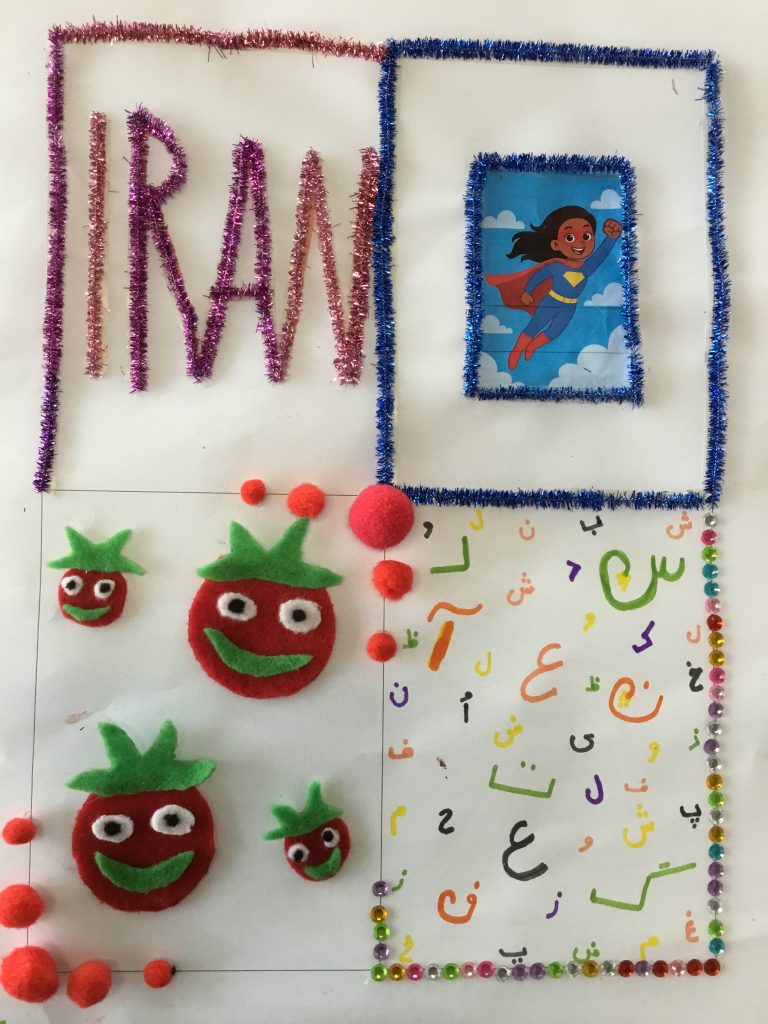
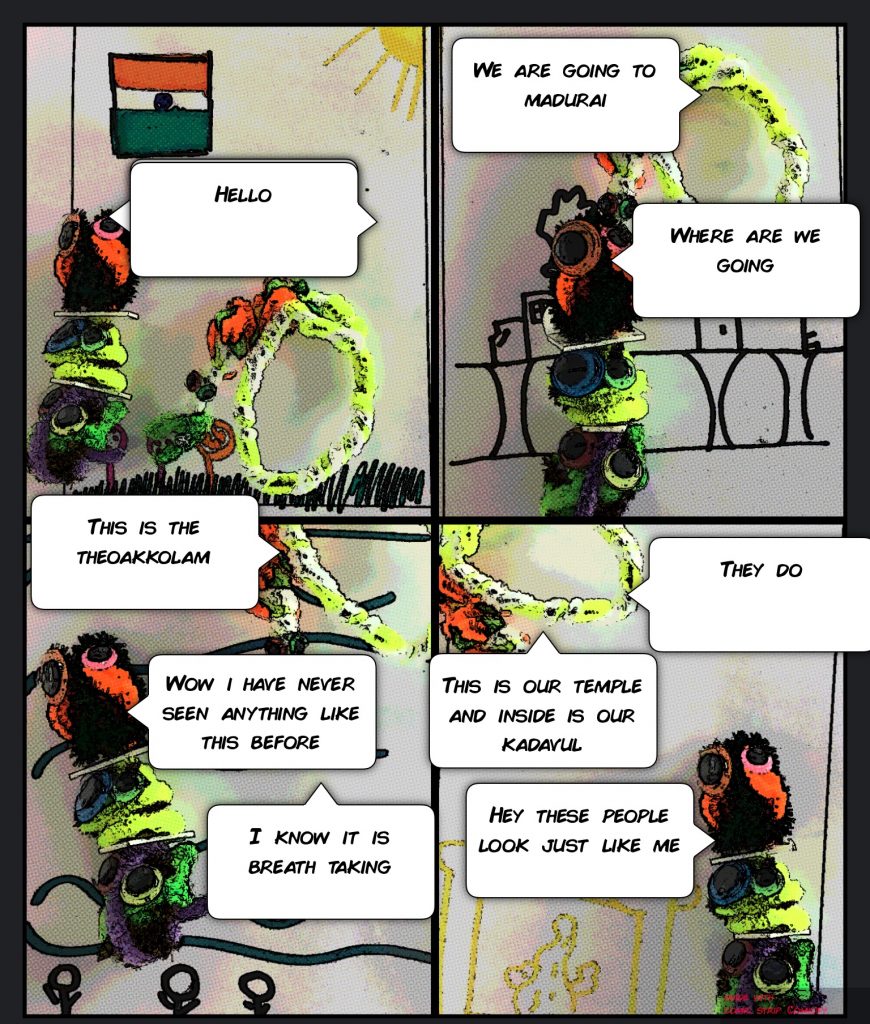
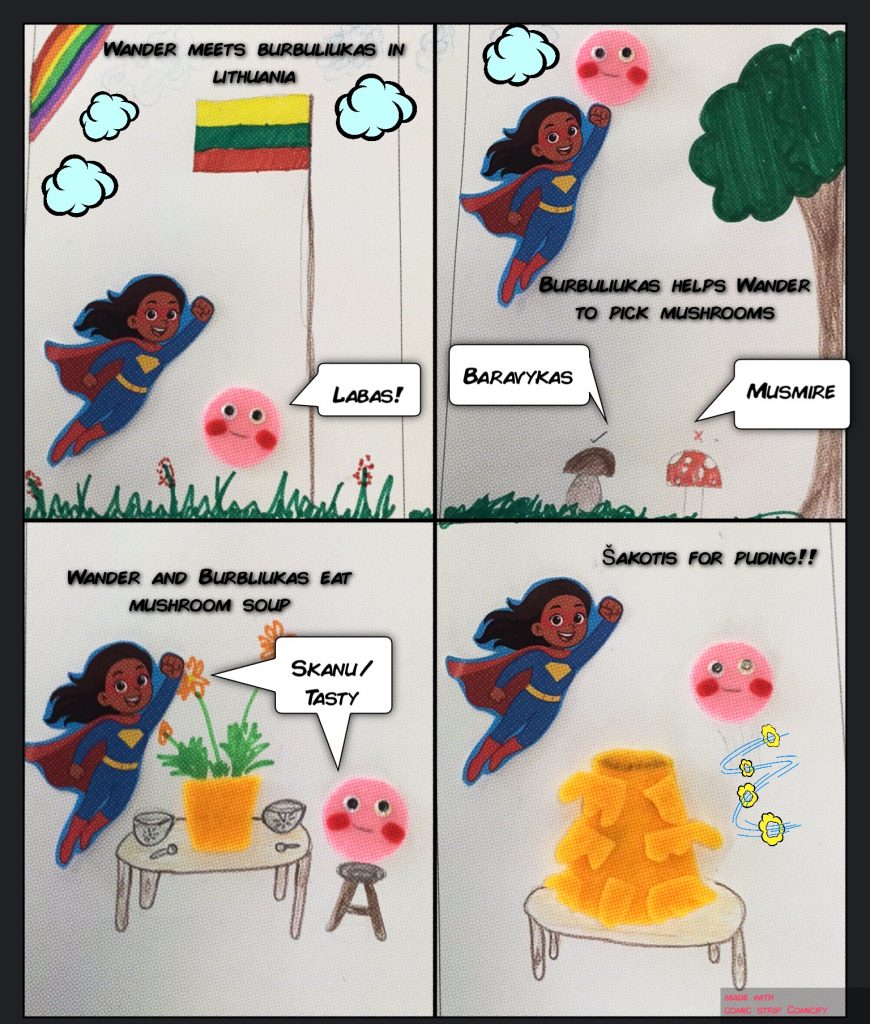
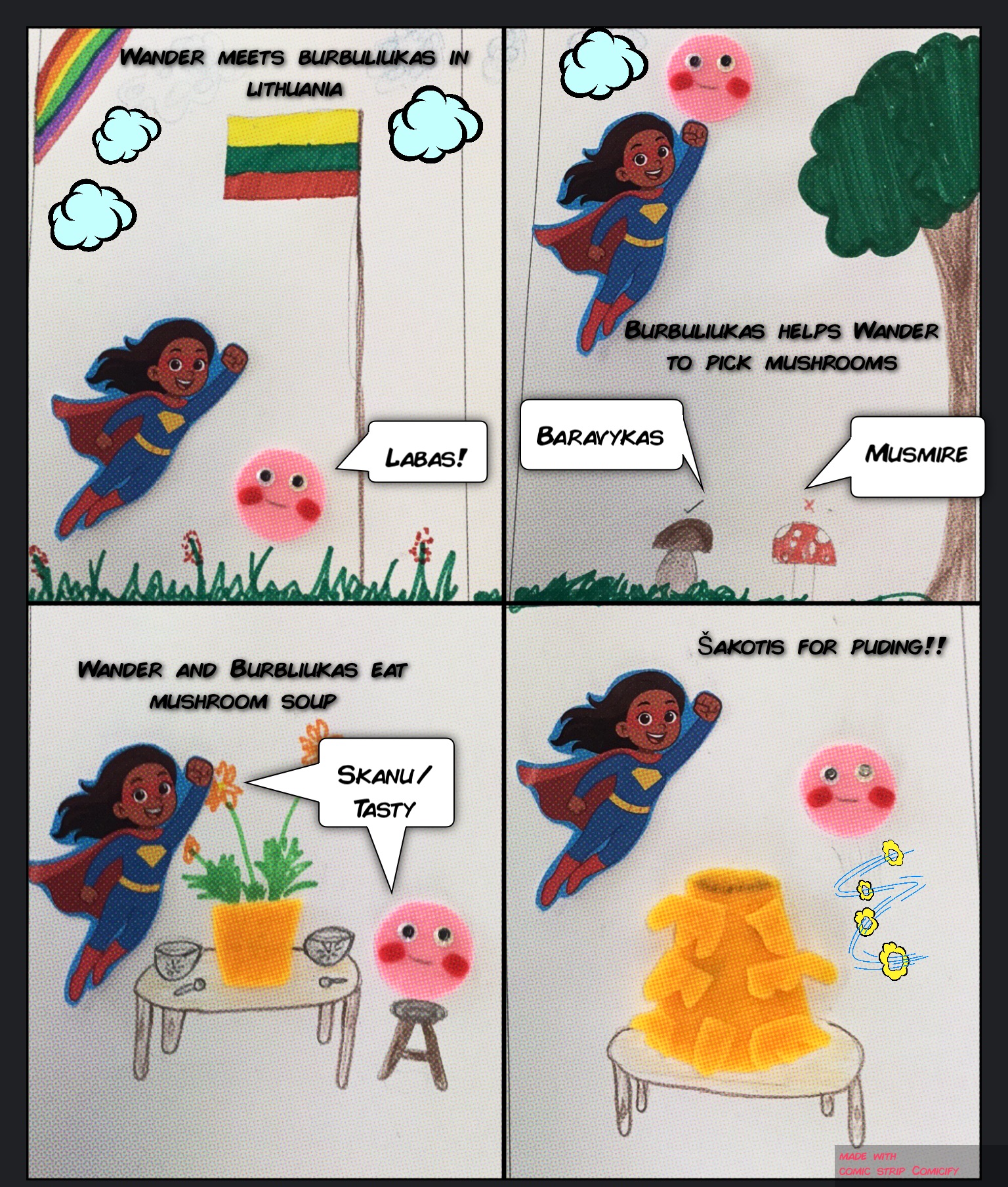
Last week I had the pleasure of running an ESRC Festival of Social Sciences event at Sheffield Hallam University titled Multilingual Comic Making. The event brought together multilingual families in Sheffield to tell stories, drawing on their full communicative repertoire (speaking, drawing, crafting, moving, vocalising). I was supported by Sexton Julia and Robyn Green who brought in valuable playwork experience, developing the space as inclusive and welcoming to linguistic and cultural diversity and rejecting ablist and colonial thinking.
The translanguaging approach we applied was developed in diverse early childhood classroom settings, collaboratively with teachers as part of an Early Careers Research and Innovation Fellowship work at Sheffield Hallam University. Through the ESRC FOSS event we wanted to understand how families would respond to this approach when it is taken out of the classroom context and not bound by the constraints of curriculum expectations and performativity. Instead, we wanted to see this as an opportunity to create translanguaging space – one in which families can engage with stories in materially, culturally and historically embedded ways. Below is some of the wonderful translanguaging work which children and families developed during the workshop. I say developed as there were iterative cycles of creating, talking, making, remaking and adding layers, at times by the grownups and at other times by the children, a living work in continuous progress. Our focus was never on a finished product or outcome; I believe this more than anything created spaces for moments in which translanguaging came to the surface.
Based on this work and with the permission of the parents we plan to develop an open educational resource for classroom and community settings.


Multilingual comic making

On 29th October, 10.30-12.30 we (Julia Sexton and Ester Ehiyazaryan-White) are offering a free interactive in-person workshop suitable for families with children in the 4-11 age range in which they will design and make their own multilingual comic strip. The workshop will include pre teaching on how to create a story board and develop characters for the comic.

The event is part of the ESRC Festival of Social Science and funded by Sheffield Hallam University. Through making and creative activities we situate learning in a storytelling context, enabling children to express and reflect on evolving and hybrid identities. Understanding these practices better and building on them in contexts beyond the home seems imperative to understanding the barriers and enablers to a racially just and inclusive society.  

What’s it about?

Globally, the mixing of languages and cultures is becoming increasingly prevalent as multicultural and superdiverse societies evolve. Our current and future working lives are influenced by increasing international mobility and require linguistic flexibility and cultural awareness.

Such work on shaping linguistic flexibility and cultural awareness begins in early childhood. However, for plurilingual families, supporting home language learning and fostering cultural knowledge is often an uphill struggle as institutional education policies rarely emphasise multilingualism as a strength.

In turn, this results in marginalising valuable multilingual home literacy practices and silencing multilingual forms of expression. Research has shown that multilingual parents often use arts based, making and creative activities to introduce home languages and cultural knowledge to their children.

Such making and creativity situates learning in a storytelling context, enabling children to express and reflect on evolving and hybrid identities. Understanding these practices better and building on them in contexts beyond the home seems imperative to understanding the barriers and enablers to a racially just and inclusive society. 

This workshop builds on research of translanguaging and multimodality in early childhood classrooms, part of my early careers fellowship at Sheffield Hallam University. As part of making this research more open and public facing, we aim to engage multilingual families from culturally and linguistically diverse backgrounds in the practices underpinned by translanguaging theory and multimodality and developed in early childhood classroom contexts as part of the project.

Facilitated by Ester Ehiyazaryan-White and Julia Sexton, Senior Lecturers in Childhood Studies at Sheffield Hallam University

Deterritorialising language portraits in the Reception classroom

As part of the ECRIF Translanguaging and multimodality in the classroom project we experimented with language portraits in the Reception class involving a group of multilingual parents and children (the idea for the language portraits activity was repurposed from the wonderful Multilingual approaches through art project here). The teacher (where possible) grouped parents and children in linguistically similar groups (for example one group contained Polish; Slovak but also Tetum – language of the island of Timor-Leste; another included Pashto, Urdu; and a third included Hausa and Yoruba). We encouraged embodied communication by providing large rolls of paper on which children could lie still and others could contour their body shape, before decorating and annotating the outline with body parts in different languages.  

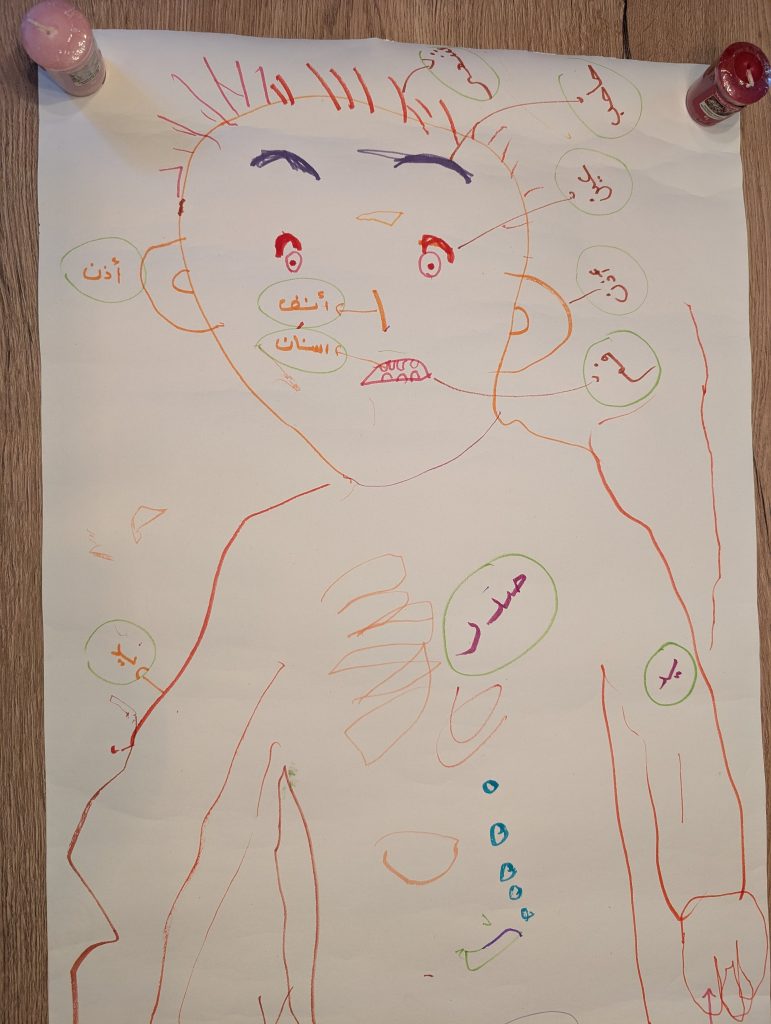
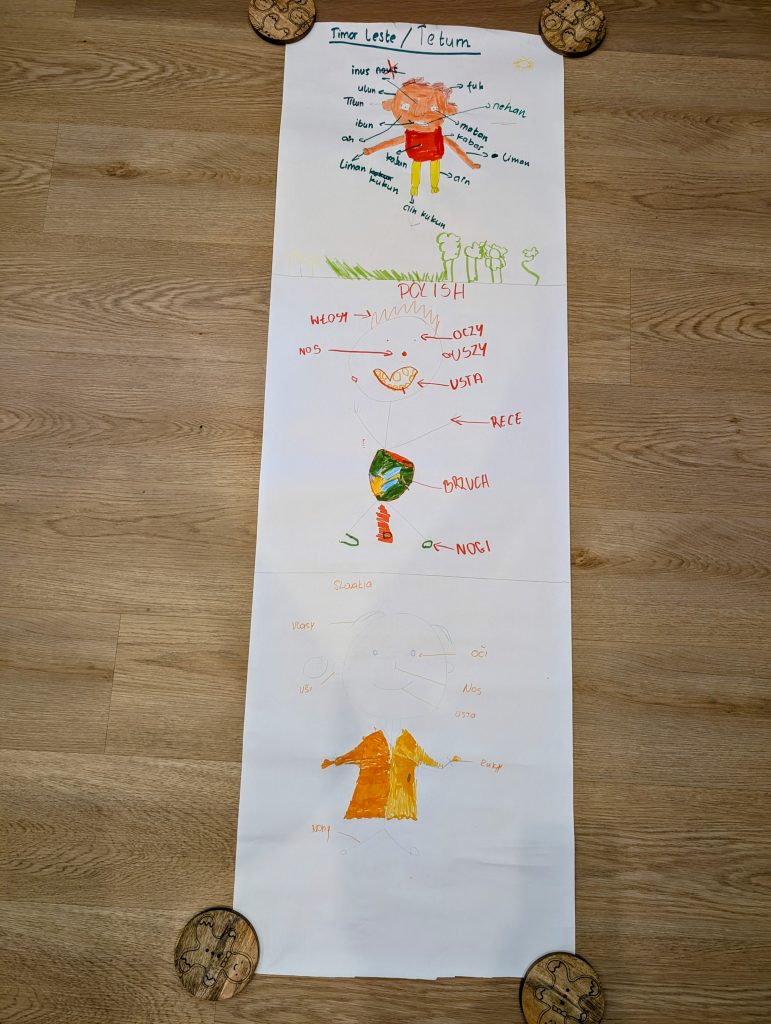
Interestingly, in some groups parents worked with one outline and annotated this with multiple languages (see Figure 1). In other cases however, parents divided the sheet into three smaller parts and drew separate smaller body outlines, annotating each with their home language only (Figure 2).

Figure 1: Language portrait annotated with multiple languages

In this way we ended up with plurilingual language portraits and single language portraits. I am transcribing the video data in ELAN, which shows that the parents’ decision making took place through gesture and rearrangement of bodies and materials around the shared table. In this decision-making children stood back and waited for the parents to organise the space and the interaction. My initial observation is that children participated – drew, scribbled, vocalised – more around the large, plurilingual language portrait outlines. Parents dominated and directed annotations and mark making more in the smaller, single language portraits. This reminds me of Julie Fisher’s guidance, to notice reflect on which of the interactions are child-led and child initiated and which are adult determined and led (2016).

Figure 2: Territorialising the language portraits

This also makes me think about how translanguaging theory questions the dominant perception of languages as bounded systems and offers opportunities for subverting such division (Blackledge and Creese, 2014; Canagarajah, 2013). My initial reflections on this observation are that children find subverting such divisions natural and seem to do this eagerly. For adults/ parents this seems more challenging, as in the group described above, who early in the interaction divided the large roll of paper into three smaller territories.

Overall however, parents and children enjoyed the activity. To quote the teacher: ‘We got really good feedback from parents for our first activity, they really enjoyed it and reported that the children were happier to use their home languages at school.’ 

References:

Blackledge, A. & Creese, A. (2014). Heteroglossia as Practice and Pedagogy. In A. Blackledge & A. Creese (Eds.) Heteroglossia as Practice and Pedagogy. (pp. 1-18). Springer.

Canagarajah, A. S. (2013). Translingual practice: Global Englishes and cosmopolitan relations. Routledge. doi:10.4324/9780203073889

Fisher, J. (2016) Interacting or interfering? Improving interactions in the early years. McGraw-Hill, Open University Press.

This blog post is licensed under a
Creative Commons Attribution 4.0 International License, CC BY 4.0

Reflections on oracy, dialogic teaching and the UKLA conference 2024

This summer (5-7 July 2024) I had the pleasure of attending the UK Literacy Association conference in Brighton, ‘Making a Difference’. The conference has a broad focus going beyond traditional literacies of reading and writing and acknowledging embodied, neurodiverse and multiliteracies. As the conference attracts a hybrid teacher, practitioner and academic audience, I was very interested in how teachers and researchers would respond to the increasing focus on oracy in taught curricula. This focus on oracy has been introduced by the DfE through government commissioned reports (e.g  Voice 21) and partly in response to post-pandemic concerns about children’s spoken language. The current newly elected government further emphasises a focus on oracy in its Labour Manifesto, which states ‘Labour will fund evidence-based early-language interventions in primary schools, so that every child can find their voice.’ In response to this, there is currently a proliferation of school-based speech and language intervention programmes, aimed primarily at children from disadvantaged backgrounds in early years and primary school settings.

It is necessary to acknowledge however, that literacy researchers and practitioners (including many at UKLA) make a distinction between oracy and dialogic teaching (Alexander, 2020) According to Alexander in oracy teaching the emphasis is on teaching the skills of speaking and listening, with outcomes such as clear speech production and articulacy (sounding confident). This positions oracy as an employability skill, on the basis of which there have been claims linking oracy to social justice (Bercow, 2018; Voice 21). Raciolinguists have challenged these claims, pointing out that socio economic issues such as children growing up in poverty require socioeconomic, not linguistic solutions (Cushing, 2024; Flores and Rosa, 2015). In contrast, and as Alexander outlines in his framework for dialogic teaching, the distinct feature of dialogic talk is the reciprocity of ideas and thoughts – it is in the interaction of talk between learners and between teacher and learners, that thinking and criticality can develop and creative ideas can flourish. Dialogue is therefore inherently reciprocal, cumulative and mutually supportive – features which are missing from oracy’s preoccupation with teaching for proficiency in receptive and expressive language.

Social justice furthermore, can be enacted at classroom level through dialogic teaching. Drawing on research evidence from the DIALLS project, ‘Teaching children to be tolerant, empathetic and inclusive through talking together’ Fiona Maine (2024) emphasised the need to build a dialogic space where children learn to notice whose voices dominate, and whose voices are marginalised; in the process developing respect and giving space for each other to contribute.  

It remains to be seen how the government’s priorities around enabling children’s voices in the classroom will be enacted. As a parent of primary aged children, I would like to think they would be taught to think critically and creatively rather than correctly and articulately. The ability to doubt, question, collaboratively build ideas in my opinion will provide a much better foundation for the substantial challenges of climate change, sustainability and AI their generation will have to tackle in the future, than the ability to articulate with certainty.

References:

Alexander, R. J. (2020). A dialogic teaching companion. Routledge.

Cushing, I. (2024). Social in/justice and the deficit foundations of oracy. Oxford Review of Education, , 1-18. doi:10.1080/03054985.2024.2311134

Flores, N., & Rosa, J. (2015). Undoing appropriateness: Raciolinguistic ideologies and language diversity in education. Harvard Educational Review, 85(2), 149-171. doi:10.17763/0017-8055.85.2.149

Maine, F. (2024) More than talk. Minibook 52, UKLA.